
Book Chapter
Easy Exercises in Intonation
Tones, Half-Tones, Seconds
Published 1939 | Added September 29, 2026
Six simple intonation exercises from Jaques-Dalcroze’s “Music Movement and Ear-Training: Games and Exercises” (1939).
The children (each one representing a note) run anywhere. When the Teacher names a note, all the children who have been given this note group themselves and sing it.

The same, {ex: https://dalcrozeusa.org/app/uploads/2026/09/music-mov-and-ear-training_ch3_ex1b.png} with two notes etc.
The children are in lines of eight or ten children, each one singing a note of the scale. A soloist point with a baton to this or that child who sings her note. Then it points to others and thus improvises a melody— or the melody is know beforehand.

The children can be kneeling and when the baton conducts them they can get up.
Tones and semi-tones

For very little children it is better to stretch the arms at the side to realise the tone and to bring the hands together for the semi-tone.
The children walk, in a file, a series of two bars. The Teacher gives a note, for example {ex: https://dalcrozeusa.org/app/uploads/2026/09/music-mov-and-ear-training_ch3_ex4a.png}, while saying: semi-tone and raising the hand.
The children sing {ex: https://dalcrozeusa.org/app/uploads/2026/09/music-mov-and-ear-training_ch3_ex4b.png} while making a bend, then they sing the semi-tone above, and raise themselves half way. {ex: https://dalcrozeusa.org/app/uploads/2026/09/music-mov-and-ear-training_ch3_ex4c.png}
If the Teacher says: tone, the child raises himself completely, arms completely raised.
If the Teacher lowers the arms while saying: semi-tone, the children sing the semi-tone below.

The child sings the semi-tone above while raising himself on tip-toe, and the tone above while raising himself on tip-toe and raising the two arms.
The child sings the semi-tone below while making the gesture of greeting by raising his hat, and at the tone below raising his hat and bending the body in front.
Submit Feedback on This Resource
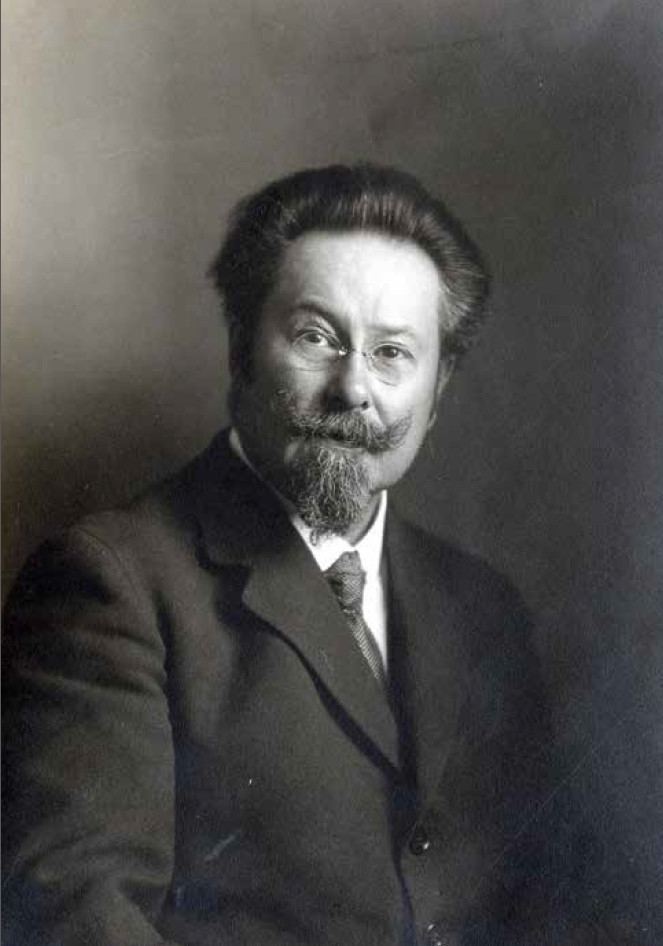
Émile Jaques-Dalcroze
Émile Jaques-Dalcroze was a Swiss composer, educator, and developed Dalcroze eurhythmics.
While teaching music at the Geneva Conservatory, he observed that his students lacked essential musical skills. They could not actually hear the music and harmonies they were writing. When they performed, their playing showed little sense of rhythmic life.
He began to devise ear training games to develop better inner hearing. These games honed the students’ perceptions and resulted in more sensitive music-making: timing, articulation, tone quality, and phrase shape. Dalcroze noticed his students would exhibit subtle, spontaneous movements—swaying, tapping a foot, a slight swinging of the arms—as they sang. The body was conscious of the life and movement of the music.
Jaques-Dalcroze began to explore these natural, instinctive gestures. He invited students to walk and swing their arms, or to conduct while they sang or listened to him improvise at the piano. He called this study of music through movement “eurhythmics,” from the Greek roots “eu” and “rythmos” meaning “good flow.”
Jaques-Dalcroze continued to experiment with eurhythmics, giving demonstrations of his “Rhythmic Gymnastics” throughout Switzerland and Western Europe. In 1911, he founded a school in Hellerau, Germany, where he refined his pedagogical methods and mounted innovative theatrical productions informed by these newly developed aesthetic principles.
These “festivals” drew audiences that included many of the leading thinkers of the day, including Rudolf von Laban, Darius Milhaud, Serge Rachmaninoff, Rainer Maria Rilke, and many others. By the time he left Germany in 1914, his work had created an international sensation.
In 1915, he founded the Institut Jaques-Dalcroze in Geneva, Switzerland where he continued to develop fresh applications of his approach until his death in 1950. The school continues to train new instructors who have, in turn, established training schools internationally.
Today, people from around the world study this remarkable method of music education and experience.
About the Author(s)
Émile Jaques-Dalcroze
Émile Jaques-Dalcroze was a Swiss composer, educator, and developed Dalcroze eurhythmics.
While teaching music at the Geneva Conservatory, he observed that his students lacked essential musical skills. They could not actually hear the music and harmonies they were writing. When they performed, their playing showed little…


Leave a Reply
You must be logged in to post a comment.