

Review
Book Review
“Learn to Improvise” by Leslie Purcell Upchurch
Published Fall 2024 | Added May 17, 2025
Reading the book Learn to Improvise by Leslie Purcell Upchurch has made me recall beautiful memories from the beginning of my training in Dalcroze eurhythmics, particularly in the area of piano improvisation. Like many conservatory-trained pianists, I had never learned to improvise until I decided to pursue Dalcroze eurhythmics seriously as a student, and then later on as a practitioner.
One of the main challenges in learning and teaching improvisation is to follow a clearly established step-by-step process that allows the person to develop technical and musical skills at the piano. Leslie’s book is a valuable tool for both beginner students in piano improvisation and for teachers, new and experienced. It provides simple and precise exercises to enjoy improvisation from the very beginning. For that purpose, Leslie chooses to start with the use of pentatonic scales applied to an easy rhythmic pattern in simple meter.
As the book progresses, the author introduces whole-tone scales and pedal tones, which are nicely illustrated, giving the reader clear visual aids to memorize hand positions at the piano. Hand positions at the piano work as “anchors” for the beginning improviser and contribute to feeling confident at the instrument.
In lesson seven, Leslie provides specific musical examples from piano literature, such as Bartok’s Mikrokosmos. Small pieces or character pieces are excellent models for compositional and improvisational ideas such as harmonic intervals. Furthermore, the lesson gives suggestions on creating an entire story using a variety of harmonic intervals, which become sound effects. In this case, the story is about a game of cat and mouse.
To continue developing students’ improvisational skills, Leslie introduces the use of perfect intervals. I find these resources very helpful, since the sonorities created sound modern and “correct” for the average ear. Furthermore, in the following chapters, the book continues with the use of modal scales and the twelve-bar blues.
Lesson fifteen is the longest in the book because it explores, in a deeper way, the possibilities modal scales can offer and their relationships with the common major and minor scales. In addition, Leslie writes about the use of 7th chords in the accompaniment and provides easy examples for beginner pianists and non-pianists.
To enrich improvisation experiences, the author includes a paper wheel that can be manipulated, where the traditional circle of fifths is expanded with a modal twist. Once the “Russian roulette” is built, the musical fun starts by spinning the wheel to end up in unexpected keys.
A unique trait of Learn to Improvise is the introduction of the Japanese hirajōshi scale at the end of the book, which adds one more possibility for the beginner improviser. In conclusion, this book is a valuable resource in the journey toward joyful piano improvisation.
Submit Feedback on This Resource
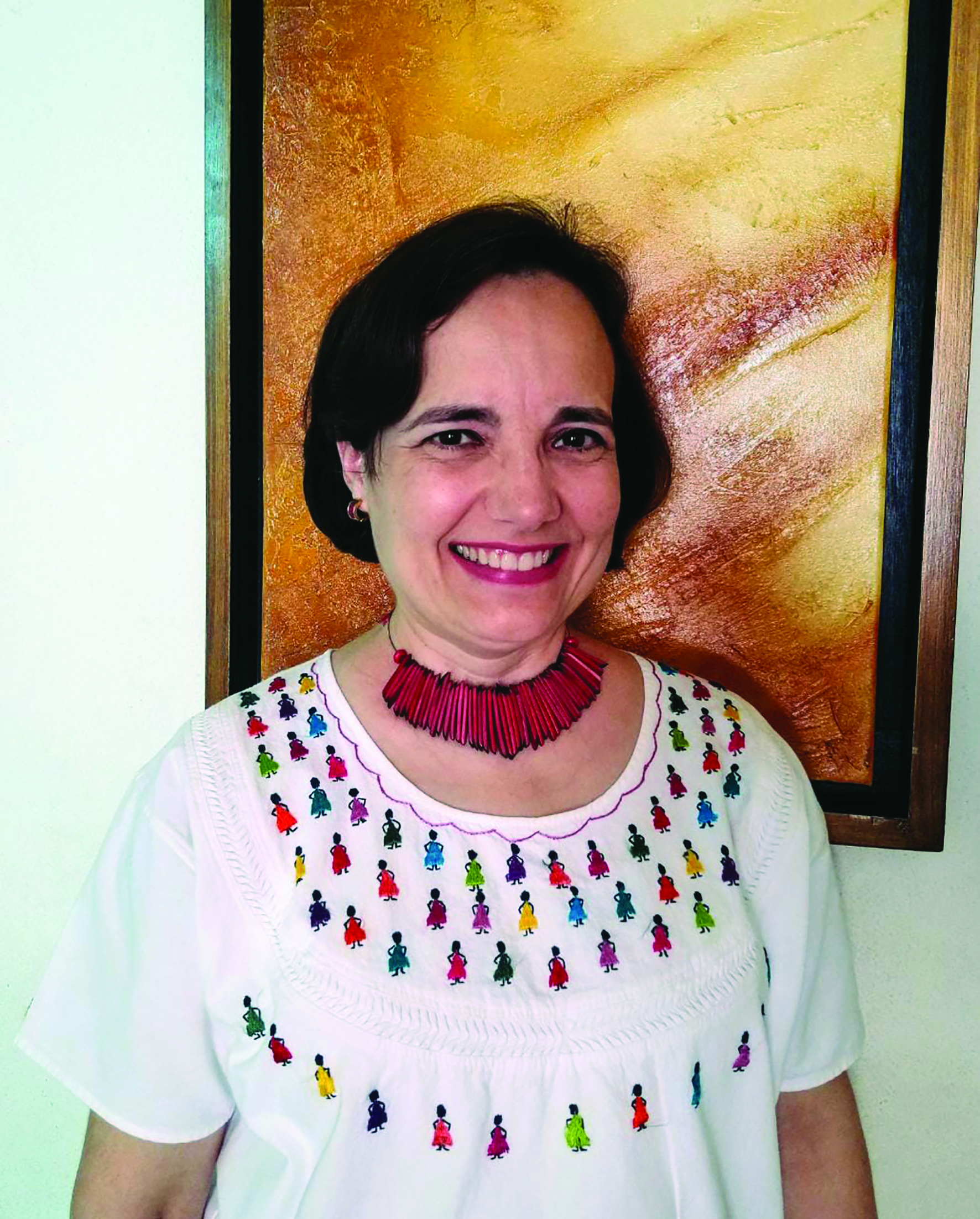
Elda Nelly Treviño
Dr. Treviño is a pianist and Dalcroze Eurhythmics (DE) practitioner and researcher. She is a professor and coordinator of Programas Dalcroze at the Universidad Panamericana in México City. Alongside she is a professor at the Facultad de Música of the Universidad Autónoma de Nuevo León (UANL) in Monterrey, and director of her independent studio “Música Viva”. As active promoter of DE throughout Latinamerica, Elda Nelly frequently serves as guest lecturer, and clinician in DE and piano pedagogy. Up to the present she serves as a member of the publications committee of the Dalcroze Society of America in the US, and as a representative of the FIER in México. In addition, she is active as a collaborative pianist. Dr. Treviño holds a Ph.D. in Psychology from the Universidad Autónoma de Nuevo León, Bachelor and Master of Music in Piano Pedagogy from the University of Texas at Austin, Dalcroze Certificate and License from Carnegie Mellon Univeristy.
About the Author(s)
Elda Nelly Treviño
Dr. Treviño is a pianist and Dalcroze Eurhythmics (DE) practitioner and researcher. She is a professor and coordinator of Programas Dalcroze at the Universidad Panamericana in México City. Alongside she is a professor at the Facultad de Música of the Universidad Autónoma de Nuevo León (UANL) in Monterrey, and director of he…


Leave a Reply
You must be logged in to post a comment.