
Lesson Plan
Organic Rhythm
The Music of Silence
Dated January 18, 2020 | Added August 16, 2025
This lesson explores natural rhythms that accompany movement. These rhythms can be inspired by the breath, the heartbeat, or other sources of bodily motion; by spatial pathways and other spatial elements; or by moving in relation to others, among other variables.
Participants also explore Laban’s types of phrases: impulse, impact, swing, and continuous, ultimately choreographing individual sequences that retain their own rhythmic integrity while responding to environmental influences—including recorded music. Participants play with these phrases, again with recorded music, engaging in a dialogue that informs and enhances the dance.
Lesson Plan
Finger Warmup
- Find a partner, and spread out and make silent rhythmic patterns. Using a variety of dynamics, touch your partner with your finger to have them initiate movement from different body parts, e.g., shoulder, upper back, knee, chin, etc.
- When you feel inspired, switch roles with your partner. See if you can communicate the switch without speaking. Play around with when and how you switch over. After touching your partner, move in response yourself.
- Finally, bring it to a conclusion.
Moving through the Space
- Begin to walk through the space, and be aware of all of the different parts of your body.
- Put your hand on your sternum—give it a little knock.
- Pause and find the gentle expansion and contraction of your sternum. Pretend you’re pulling a string, and the string pulls the sternum. Not the shoulders.
- Change the speed of your movement, do it a bit faster and faster. Feel the sternum moving easily.
- Now, find a comfortable place where your sternum is open.
- Go back to walking. Pay attention to the space, take everything in simultaneously, not looking at any one person or thing in the space.
- You have eyes all over your body. We call this the molecule dance.
- Speed up to a fast walk. Let yourself experiment with directions.
- Take it to a little jog. Because of the eyes all over, you will not bump into anyone.
- Take up a lot of space!
- Come back to a slower jog.
- And come back to a walk.
- Let your heart and lungs come to a gentle place. If you’d like, you can do a nonverbal acknowledgement of those around you.
- Come to a stop, and pay attention to your heartbeat.
Finding the Rhythm of Pulse
- Find the beat of your heart, and play around with that pulse in your body.
- Find micromovements of the pulse with different parts of your body; see other people’s pulses.
- Find another part of the body to put the pulse in.
- Go back and check your pulse. Has it changed?
- Sing the pulse gently to yourself.
- Find another micromovement in your body for the pulse.
- Go back and check your pulse.
- Now, step your pulse through the space.
- You can sing along with your pulse if you want to.
- Find someone else that has a similar pulse. When you find them, pulse out with them.
- Sing with your pulse buddy.
- Finish up your dialogue with a facial departure.
Finding the Rhythm of Breath
- Find a spot on the floor, and make yourself comfortable.
- Pay attention to the rhythm of your breath. Breathing is both a volitional and a non volitional activity. Take nice deep breaths. Let your breath find its own rhythm.
- Let yourself begin to move with your breath rhythm. You can make your breath audible, and make some easy gestures. Make it comfortable and luxurious for yourself.
- Stretch different parts of your body, and bring it into your breath rhythm.
- Here are some other rhythms the breath can take:
- You could be intense about something, when you hold your breath.
- Or a heavy sigh, of disappointment of frustration.
- Or the breath when you are really laughing—or crying! It’s sometimes the same energy.
- Or a deep breath of relaxation—from your neck down to your tailbone. Let it out with a nice sigh.
- Feel these in your body somewhere.
Finding the Rhythm of Weight
- Take your right arm, and feel its weight.
- Move around through the space, feeling the rhythm of weight, of heaviness.
- Find someone to gesture with, a conversation of weight.
- The opposite of heaviness is being light.
- Go back and forth between these two places.
- Gesture to someone across the way with a light gesture.
- Try a light and quick—urgent—gesture.
- Now light and sustained—otherworldly.
- Now a strong gesture!
- We have light, heavy, strong…we also need limp.
- Its like heavy, but it’s not. Like a limp handshake. It’s nonexpressive.
Finding the Rhythm of Architecture
- Part 1: Discovering the Space
- Move through the space. What rhythms do you notice in the space? Are there patterns in the space? Are there patterns within the patterns of the space?
- Look around at other people, you may get ideas.
- Sing your rhythms of the space.
- Find a partner to have an architectural conversation with. Hold on to your own while you have the conversation.
- Now, add stillness to your repertoire, but keep your conversation going.
- Part 2: Choreography
- With your partner, take a couple of minutes to choreograph a short piece based on your sound and movements. Make a little piece.
- Find another pair, and share with them your duet.
- Part 3: Reactions and Responses
- Were there any moments in your performance that seemed musical without music? Discuss.
Laban Phrase Forms
We’ll be looking at four of these phrase forms—some people call them rhythms.
- The first one has the accent in the beginning, with a little follow up. [Demonstrate.]
- This one is called the impulse. Or an accent.
- Dalcroze might call this crusis.
- This one is the opposite, with the accent at the end. [Demonstrate.]
- This one is called impact.
- Dalcroze might call this anacrusis.
- This one has the accent in the middle. [Demonstrate.]
- It’s called swing, but it’s not the best word for this. The accent is at the bottom of the motion.
- Finally, there is the sustained movement. [Demonstrate.]
- We’ll call it continuous.
Choreographing the Duets
- Working with a partner, your task is to create choreography with each of these four phrase forms.
- Consider each of these gestures, placing movements in different parts of your body.
- [Allow time for participants to explore.]
- Get clear about what your choreography is—decide clearly what your relationship will be, what your raw materials are.
- [Allow time for participants to refine.]
- Be clear about your ending, so we know when it’s over.
Sharing in Silence
Let’s share our pieces with each other. Use this time to become more aware of your choreography.
As we go, consider how we might choreograph these duets, for when we share with an audience later. Ultimately, I’ll add music as another layer of additional context. Your purpose will be not to change your movement to match the music. Instead, the music will support your movement and maybe give suggestions.
Sharing with Music
This time, I’m going to add some music in. You’re not going to lose yourself to the music, but let it enhance your movement. There will be both silence and music.
Be sure to think about where you are in the space, and entrances into the space.
Submit Feedback on This Resource
Dawn Pratson
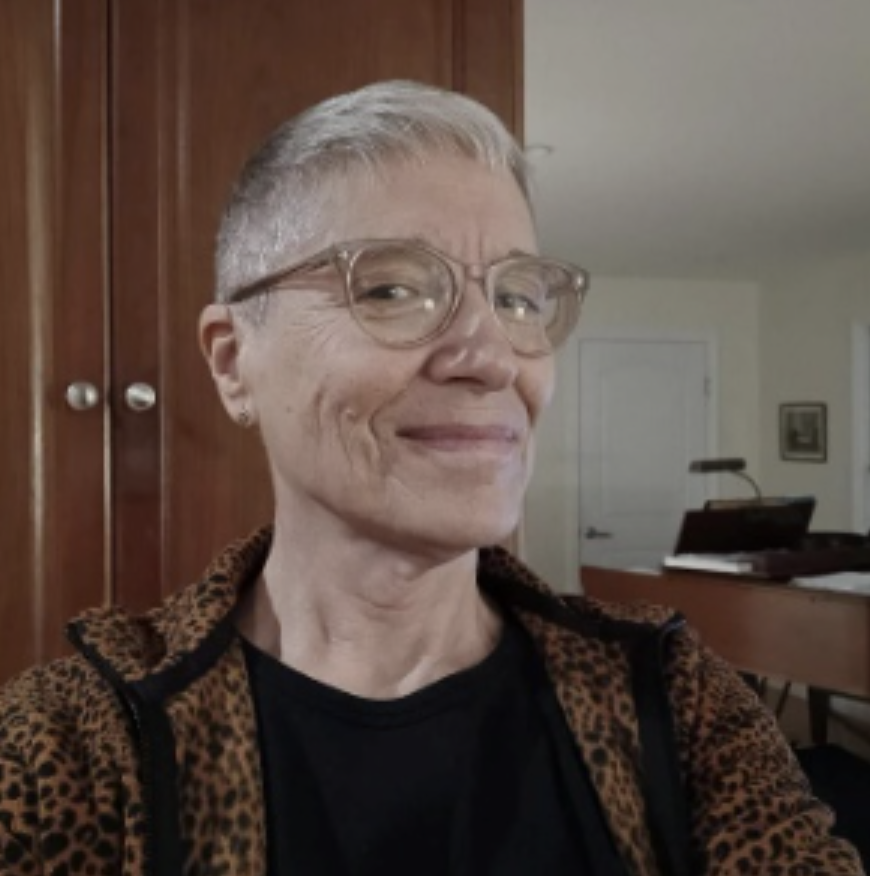
Dawn Pratson is an interdisciplinary artist—dancer, choreographer, musician—and educator, with a background in creative arts in therapy. She earned her Dalcroze license and certificate from the Longy School of Music of Bard College under Lisa Parker and Anne Farber. Dawn was on the faculty of the Longy Dalcroze programs from 1997 until 2015, and she was the founding music specialist at the Folk Arts-Cultural Treasures Charter School in Philadelphia. Currently, Dawn teaches for the Dalcroze School of Music and Movement, teaches and performs with Michael Joviala in the group “Locomotors,” and serves on the Dalcroze Society of America’s diversity, equity, and inclusion committee.
Organic Rhythm
The Music of Silence
Dawn Pratson, Author


About the Author(s)
Dawn Pratson
Dawn Pratson is an interdisciplinary artist—dancer, choreographer, musician—and educator, with a background in creative arts in therapy. She earned her Dalcroze license and certificate from the Longy School of Music of Bard College under Lisa Parker and Anne Farber. Dawn was on the faculty of the Longy Dalcroze programs fro…


Leave a Reply
You must be logged in to post a comment.