
Article / Essay
The Cahiers of Émile Jaques-Dalcroze
Anatomy of a Lesson
Published Winter 2019 | Added October 13, 2026
Explore an original lesson plan by Émile Jaques-Dalcroze through Ruth Alperson’s translation and analysis, with additional commentary by Bill Bauer and Michael Joviala.
Editor’s note: I spent the fall of 2018 studying at the Institut Jaques-Dalcroze in Geneva, Switzerland. While I was browsing through the stacks in the library one day, a slim notebook found its way into my hand. In it were 15 typed (on a real typewriter) pages bearing the Institute’s stamp of approval, and the hand-written words “Diplôme juin 1976.” I knew instantly that I wanted to publish it. Those of you who know Dr. Ruth Alperson will immediately recognize her voice: the clear, concise wording; the penetrating analysis; the seemingly effortless flow… all fully formed here in the first half of her Diplôme memoire.1 Her analysis of a class given by Emile Jaques-Dalcroze, taken straight from his own notebooks, reveals two singular minds at work and in resonance a mere 33 years apart. Aside from an opening paragraph that makes wistful mention of a different era in education, it is itself timeless; and so I am pleased to present it here largely as it originally appeared. I hope you enjoy it as much as I did!
Michael Joviala
In the era of the open classroom and the free school in the West, one is aware of an increasing emphasis in education on the importance of the tactile sense in the learning process. It is in this context that eurhythmics as a method of teaching music is both relevant and adaptable to the modern curriculum. The foundation of this method has its roots in the first half of this century, when Emile Jaques-Dalcroze put into practice his belief that the natural rhythms in physical movement provide the best basis for experiencing and reproducing expressively that which is heard in music. Thus, in the eurhythmics class, it is the body that becomes the musical instrument, and a tool for learning.
Those who have studied with M. Jaques2 speak of his remarkable musicianship, his ebullient personality, his energy and dynamism, his ability to infuse his classes with joie de vivre. These qualities nurtured a method that grew and flourished for decades and led to the establishment of Dalcroze Eurhythmics centers in Switzerland and elsewhere. M. Jaques was a prolific writer and composer, lecturer, and teacher. He was a great organizer, and exposed the public to the work of his students through numerous performances in and outside Geneva. After his death in 1950, M. Jaques’ approach developed and changed with the times, while keeping the original spirit intact. Today, there are centers of Dalcroze education in Switzerland, Australia, Canada, England, Germany, Israel, Mexico, The Netherlands, South America, and the United States.3 Students today may read a variety of books written by a second generation of Dalcrozians.
At this time it is particularly interesting to examine the work that “le Maitre” himself did in the classroom. Aside from the many volumes that M. Jaques wrote discussing the theories behind his method—Le Rythme, La Musique et L’Education probably his best known— there are the “cahiers”—over ninety beautifully bound notebooks—large volumes containing most of his lesson plans for adults in eurhythmics, improvisation, and solfège classes, spanning some 40 years of teaching. What is immediately striking here is the amount of material. It appears that M. Jaques planned and organized each class, step by step; the lesson plans from his final notebooks are written out as thoroughly and explicitly as those from 1915. Here is a methodical and precise man; despite his great talent in improvisation Dalcroze wrote out in full the rhythms and melodies he would use in what are now referred to as classic Dalcroze exercises: quick response, canon, and follow. With all of this careful planning, M. Jaques would invariably make digressions in the lesson, both according to personal whim and to what transpired in the class. After each lesson, he marked on the plans the exercises that had been completed, with the word “fait” (done), or the word “bon” (good), crossing out exercises that did not work well, and indicating those not completed.
As an educator, M. Jaques carried out this careful planning and recording not only for himself, but also for the succeeding generations of Dalcroze teachers, to be used as a reference. Dalcroze indicates, very explicitly, at the beginning of certain volumes that he intended his work in the classroom to be regarded in the context of the entire rhythmic experience; that exercises taken out of this context, literally, so to speak, would be meaningless.
If one is impressed by the sheer number of volumes containing M. Jaques’ lesson plans, one may be equally impressed by the amount and diversity of material contained in each lesson. Dalcroze would often present eight or nine musical subjects in one class, each one organized in an entirely different way from the next. That is, the combinations of body movement, organization of the class, use of space in the room, and extra objects or materials used in the lesson would differ from one subject to the next. The following is a lesson plan by M. Jaques for the third year group (the most advanced level at the time) dated November 26, 1943*.
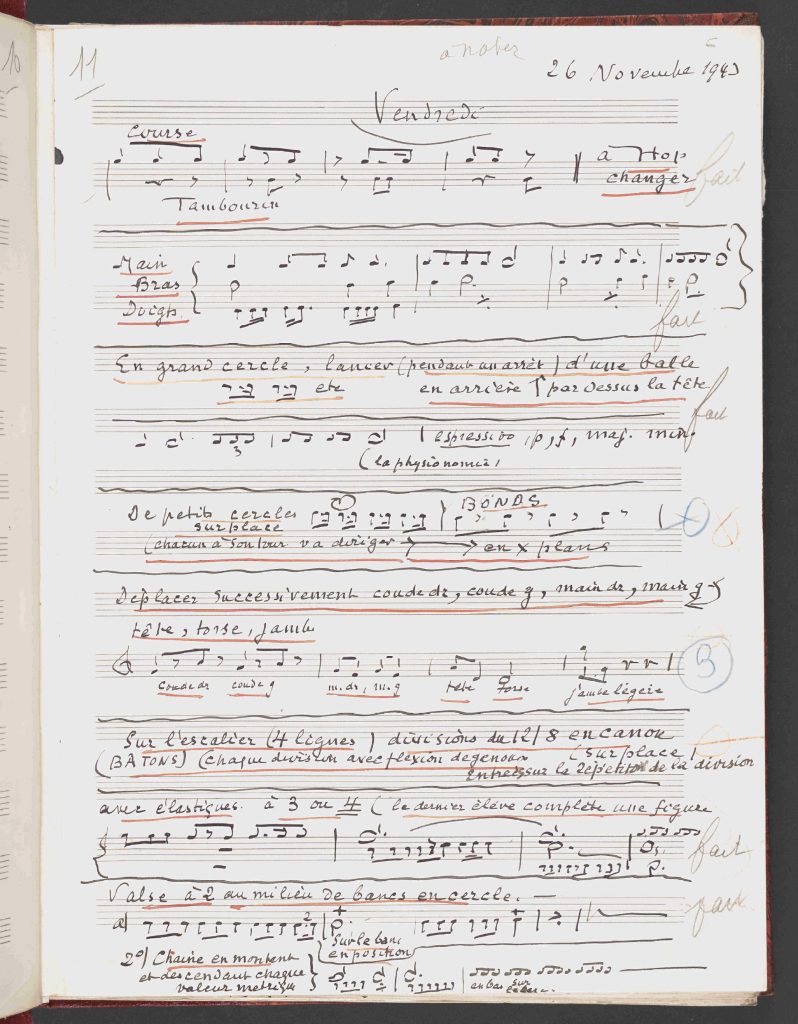
Translation and Commentary
The exercises below are first copied word-for-word from the notebooks; in the subsequent translation and analysis I have tried to make the best guess as to what actually transpired in the lesson.4
Exercise I
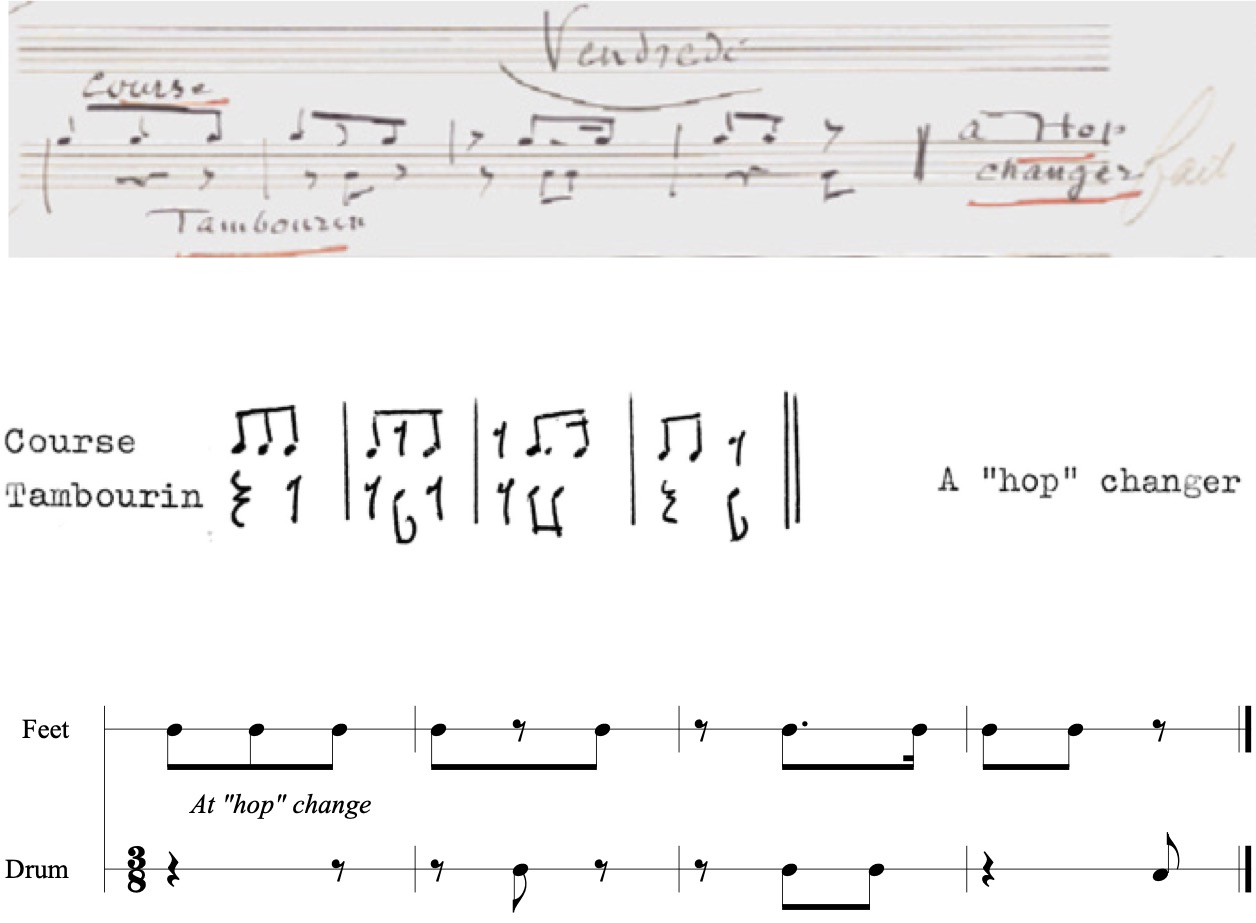
M. Jaques commences with a typical first exercise to warm up: a quick reaction, involving large movements, in this case, running freely through the room. Dissociation between hands (drum) and feet are involved in executing a polyrhythm which is tricky, although not highly complicated. The placement of rests in the upper line of the rhythm demands concentration; while the movement should be fluid and continuous, it may never become mechanical. When the “Hop!” signal is given, the hands and feet exchange rhythms. Quick reaction demands a constant readiness on the part of the students to inhibit one action and immediately begin another, develops spontaneity, and generally requires that one be fully in the present, taking in all sounds and stimuli from the outside. In an article by Dalcroze in Le Rythme entitled “Les Hop Musicaux,” he explains the basis for a signal given as an incitation5 to immediate action as being the preparation for responding to “signals” in music. After using “hop” as the signal to change, M. Jaques will express the “hop” musically; for instance, a change of harmony, tessiture, a certain rhythmic motive, now serve as a signal to commence an action.
Exercise II
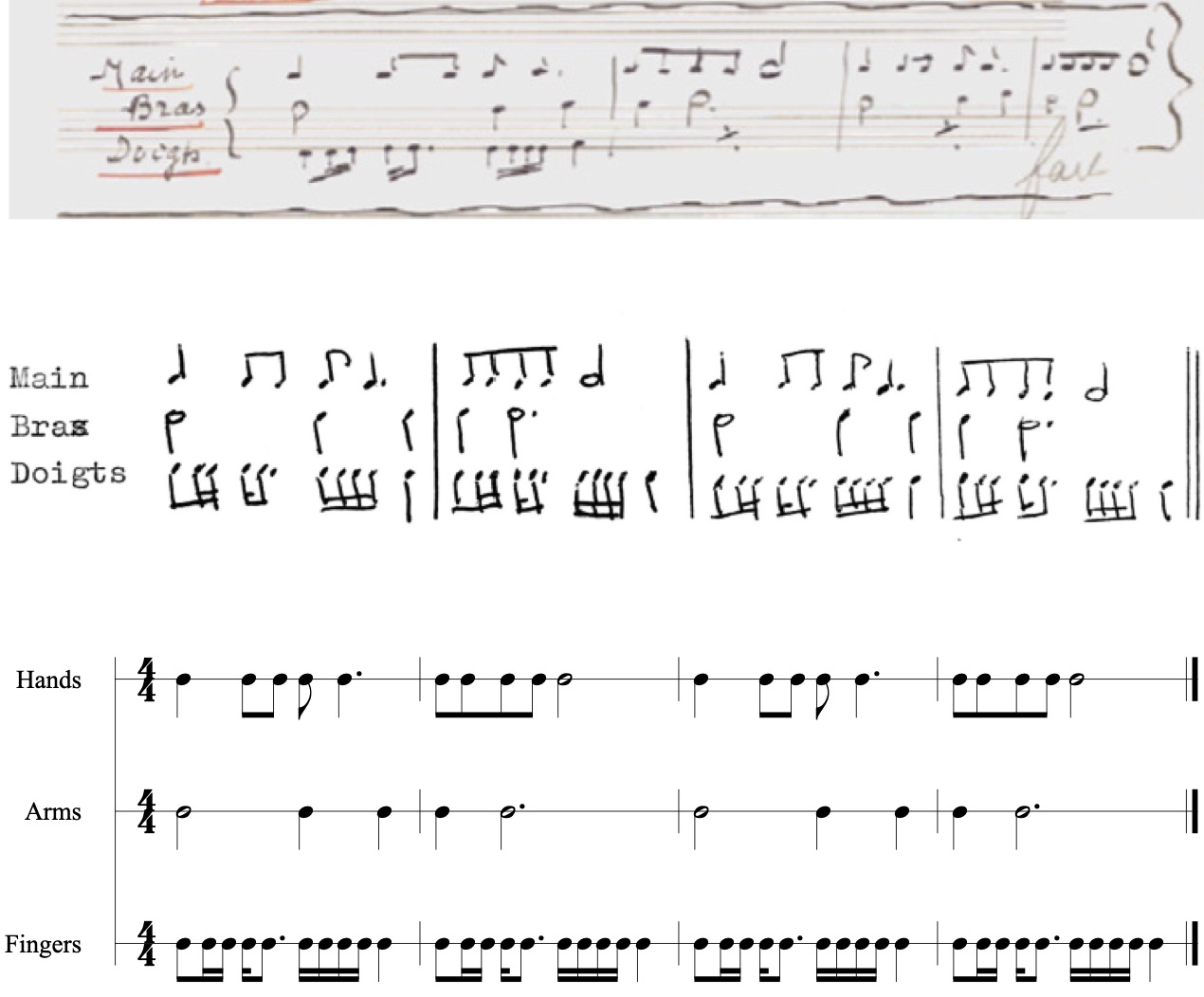
This exercise in dissociation requires the small movements of arm, hand and fingers, and a high degree of concentration. (Note that the rhythm for fingers is written in groups of five notes—one for each finger—to each half bar.) With regard to time, space, and energy, the rhythm for fingers involves the shortest durations, longer in the hand, and longest in the arm. Thus, while one is executing an exercise in dissociation, one is also learning to organize all of the different parts of the body used in the exercise into a whole.
Exercise III
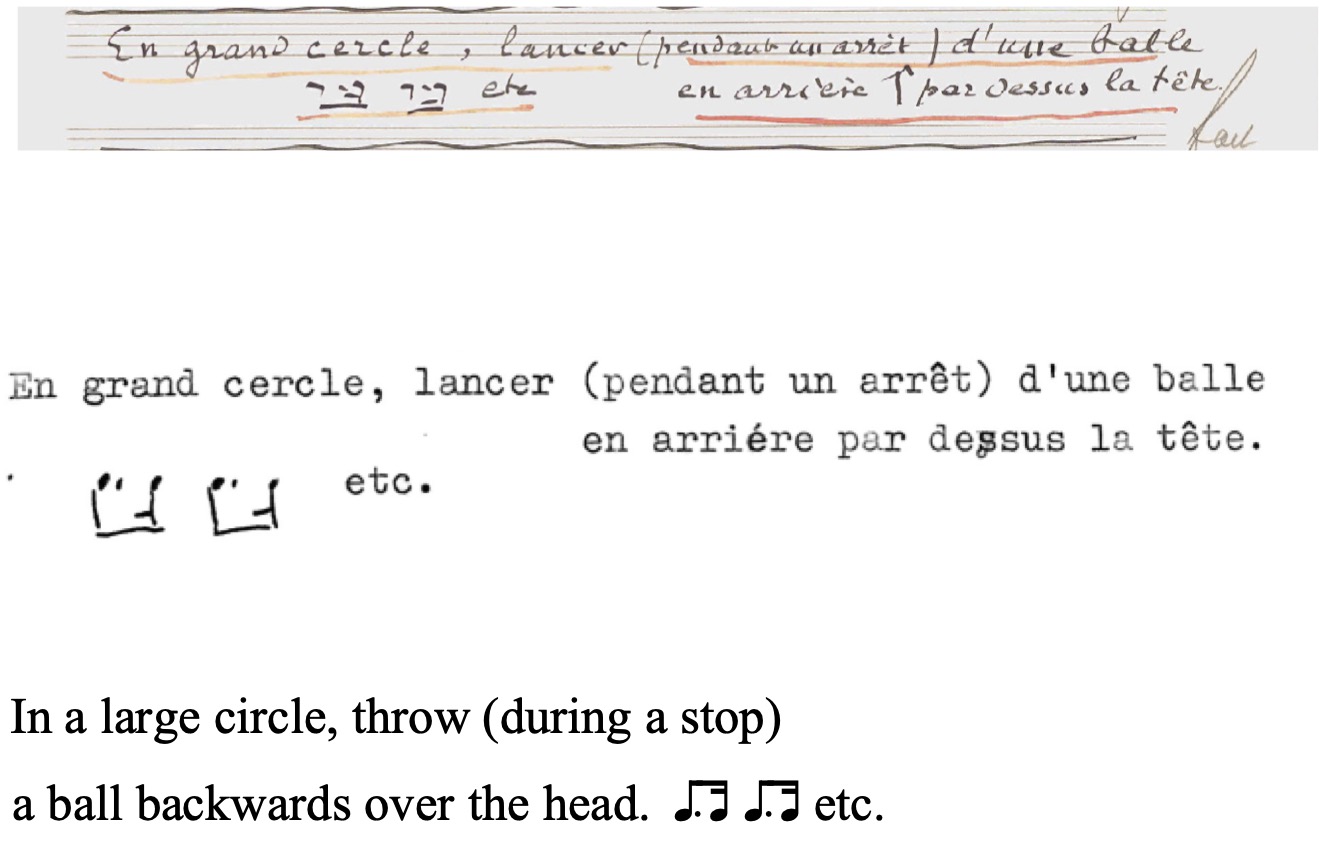
En grand cercle, lancer (pendant un arrêt) d’une balle en arriére par dessus la tête.
Now in a circle, each student holds a ball; the class skips to music improvised by M. Jaques. When a signal to stop is given (probably a pause or long duration in the music), each student stops and throws the ball over her head to the person standing directly behind. Throwing the ball correctly requires skill and judgment in the arc of time, space, and energy; then there remains the matter of catching the ball. The skipping adds vitality, making this more a game than an exercise. The forward thrust of the body with the inhibition of movement and then the delivery of the ball backward are contrasting movements, requiring different momentum, different amounts of force exerted. That the pattern of skipping and stopping is not fixed would mean that quick reaction is involved to some extent.
Exercise IV
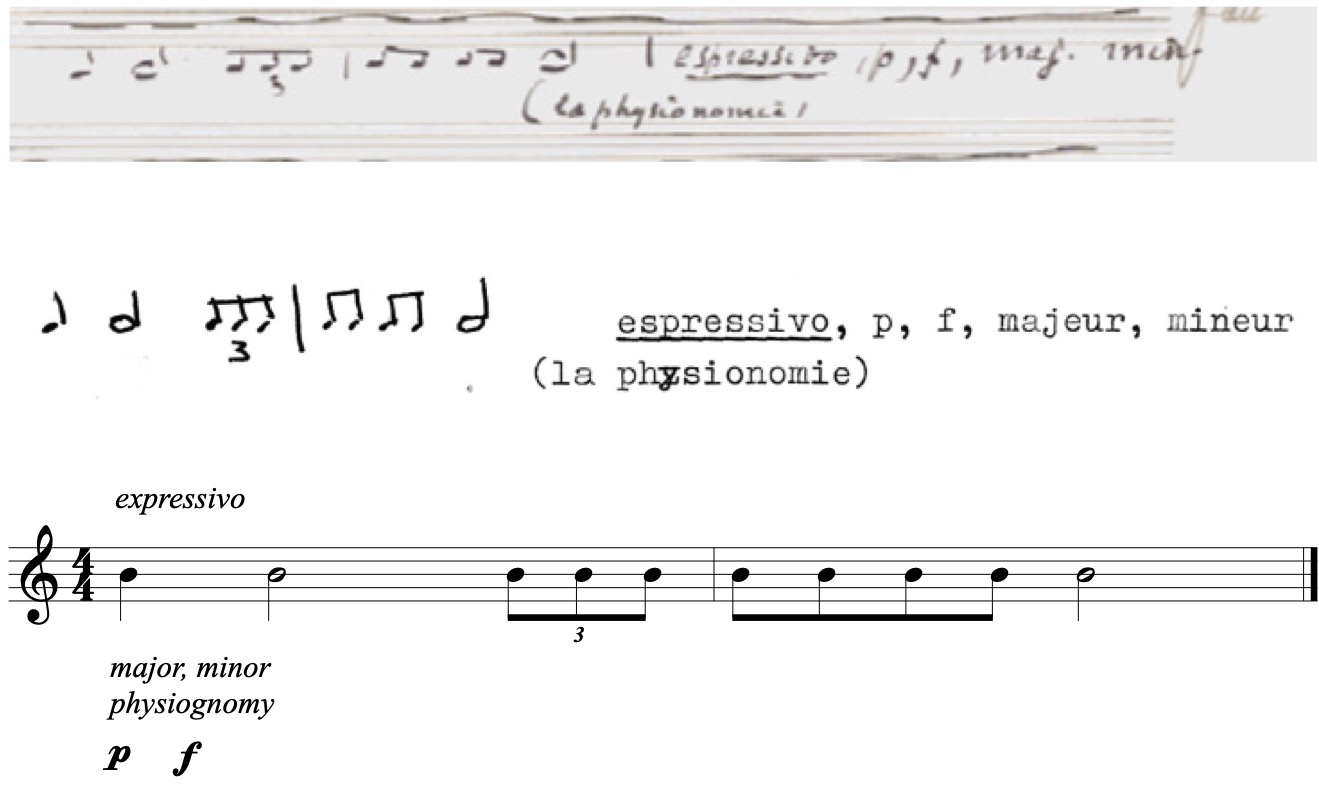
Each student moves freely about the room, stepping this rhythm, which is rendered musically by M. Jaques at the piano. The students listen for changes in nuance through movement and facial expression. Dalcroze emphasized the importance of facial expression in body-movement in the following statement from Rhythm, Music and Education:
…the mastery of body movements constitutes a mere virtuosity, unless those movements are employed to help out facial expression. The same gesture may express ten different sentiments according as the eye gives out the clue.6
Exercise V
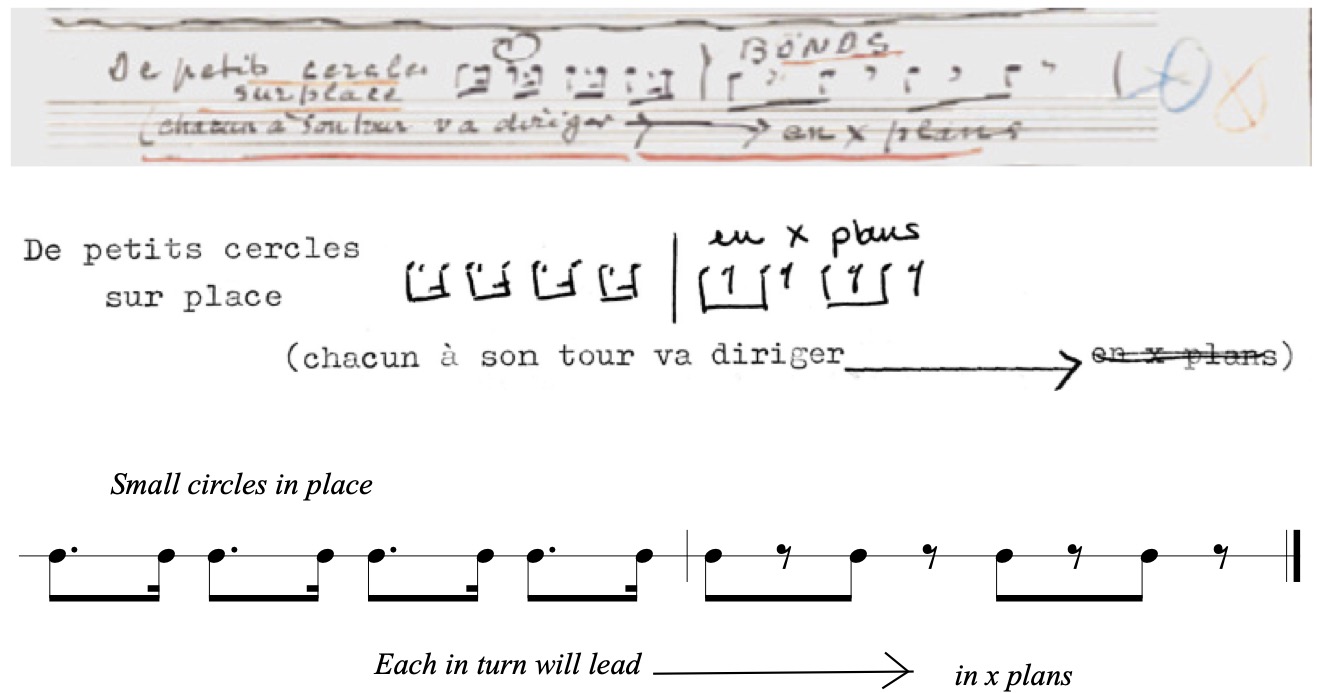
De petits cercles sur place
During a {4/4} bar of skips, each student skips in place, turning in a circle; in the following bar the student leaps to each eighth note coming on the beat and will re-commence the skipping at the new point of arrival. The dense dotted rhythm, anacrusic into the spaced pulsations of the eighth note, is affirmed in physical sensation by intense movement in a confined area contrasted with large, extended movement through space.
Exercise VI
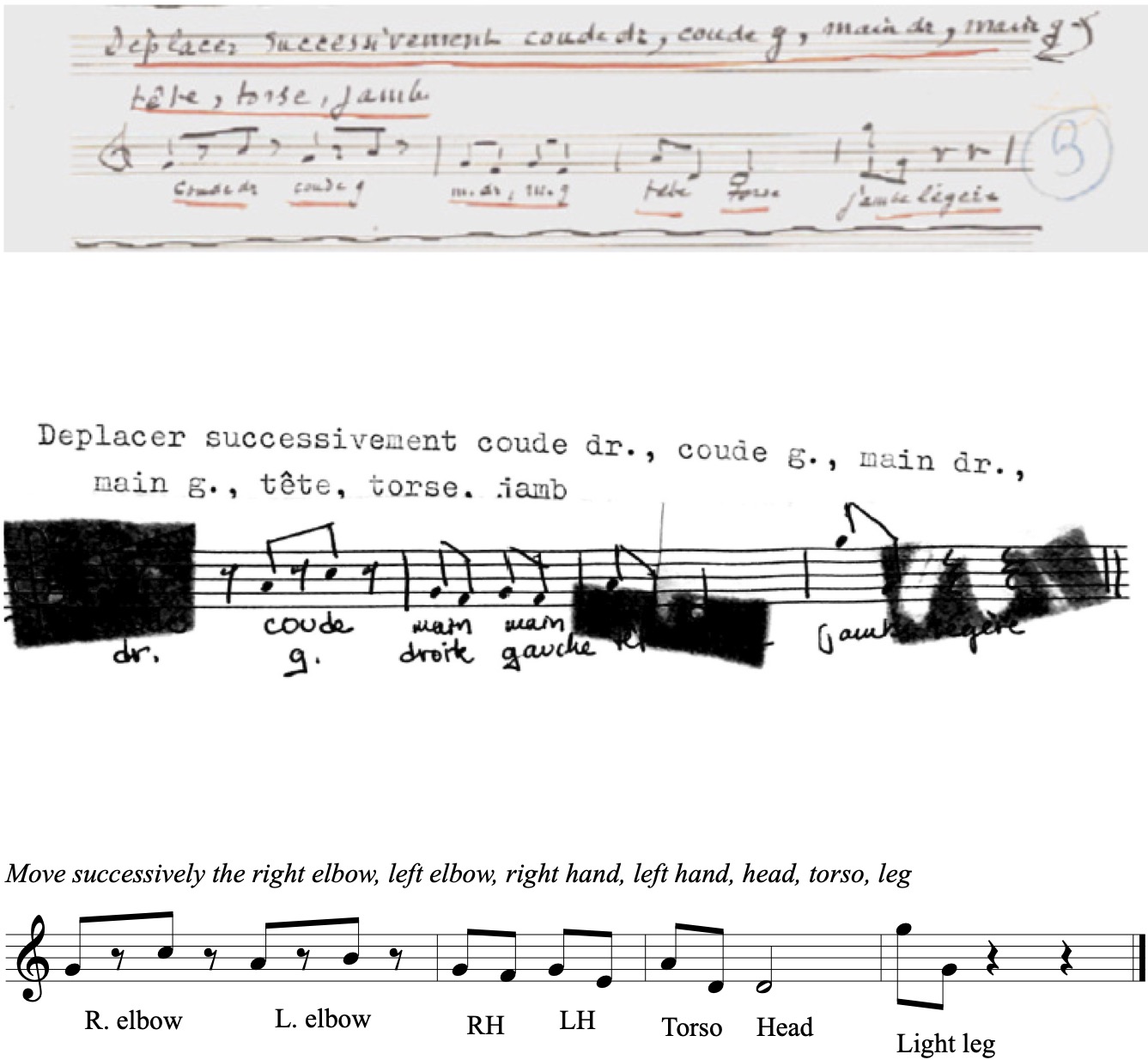
VI. Deplacer successivement coude droit, coude gauche, main droit, main gauche, tête, torse, jamb.
This exercise helps the student to develop muscular control over different parts of the body. That the movements are to be done in fairly quick succession demands a degree of facility. Hopefully, continued practice of displacement of this sort will grow from controlled movement into spontaneous movement. Writes Dalcroze:
Muscular actions, after constant repetition, pass outside the control of the brain. New reflexes can be created, and the time lost between the conception and realization of the movement reduced to a strict minimum. The cultivation of automatisms should be effected in all nuances of tempo. The cultivation of automatisms should be effected in all nuances of tempo.7
(as in this exercise) [He adds:] “conformity with these nuances depends on the perception of the degrees of muscular energy necessary for effecting the movements” (Jaques-Dalcroze, 1921, pg. 68). The rhythm used involves unequal measures, in which the pulse is successively 4 beats, 2 beats, 3 beats, and 3 beats again; the common denominator is the eight note. This is a good preparation for the next exercise, which involves the divisions of {12/8}.
Exercise VII
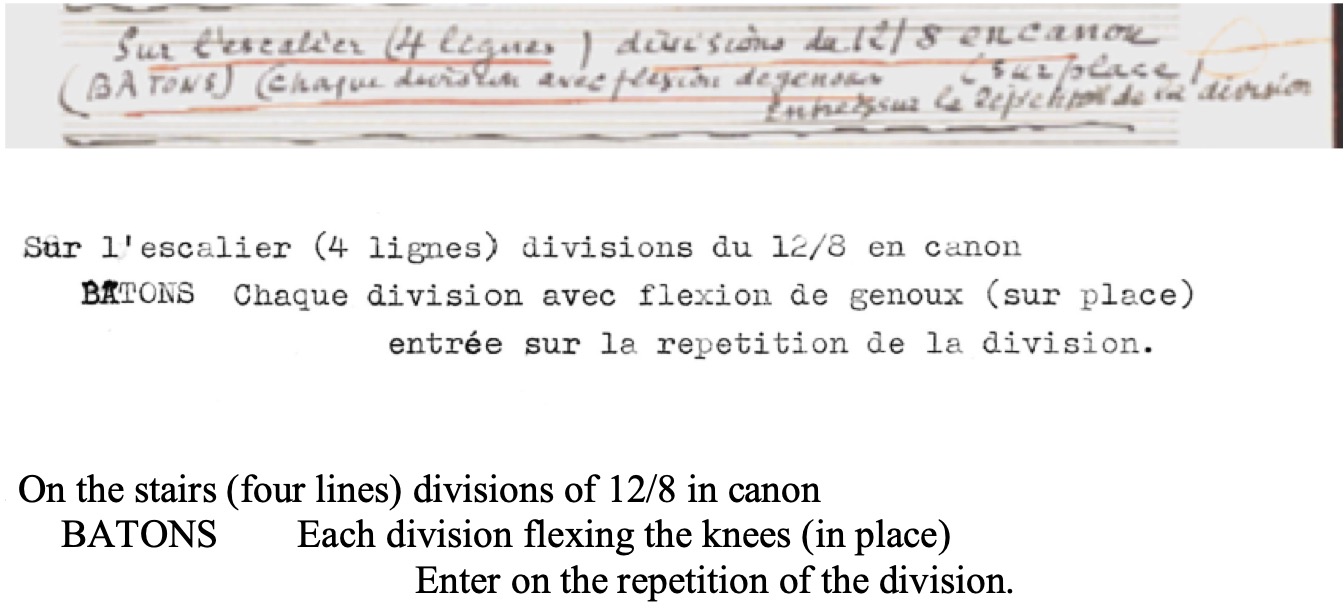
Sur l’escalier (4 lignes) divisions du 12/8 en canon.
Batons: Chaque division avec flexion de genoux (sur place) entrée sur la repetition de la division.
The class is asked to form four lines on the steps at one end of the room. Each student holds a baton. In canon, the lines will execute the different divisions of {12/8}, indicating the different pulsations in successive bars with the batons; by bending the knees, and sounding the subdivisions with the batons.
Through canon, one may experience {12/8} as the composite of all the different divisions possible.
Exercise VIII
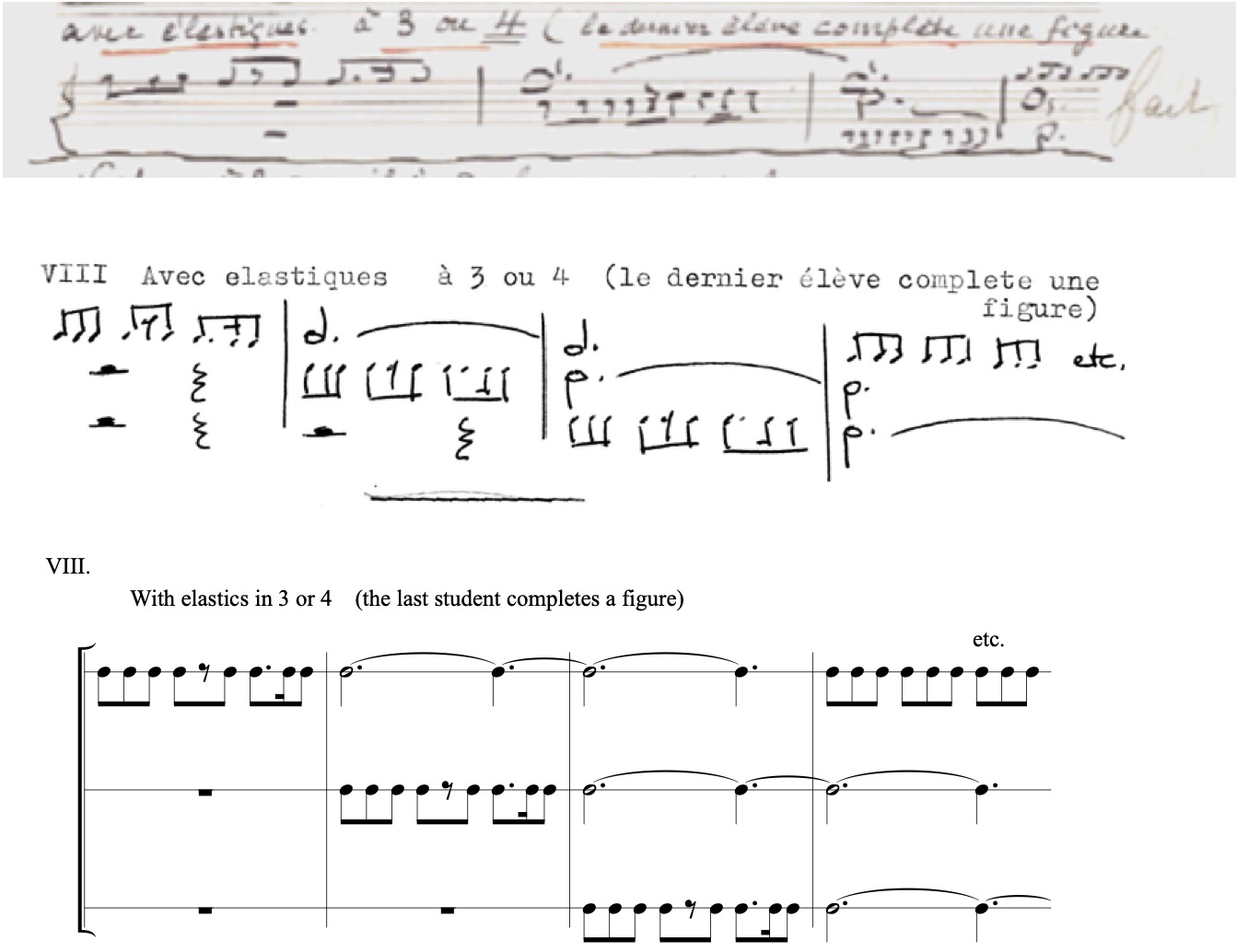
Avec elastiques à 3 ou 4 (le dernier élève complete une figure)
This rhythm, executed as in a canon involves contrasting bars of subdivisions with long durations. The former is realized in movement (running and skipping—depending on the tempo), and the latter, in the stretching of elastics, one experiences, visually and sensorially, the subdivisions of movement through space of the entire body, followed by the extension, tension, resistance (in the elastics) in the pulsation and momentum forward, of the long durations. This contrast in the rhythmic motive, and thus in the movement, is important when executed as a canon, as the two come simultaneously, resulting in design that can be visually very effective.
Closing Thoughts
Throughout his writings, Dalcroze often talks about the importance of two elements in teaching: joy and order.
The teacher of the Dalcroze method must experience joy in teaching, joy in music, and should be very clear about what he or she wishes to communicate in the lesson, and how to go about it. Former pupils of M. Jaques speak of the joy and vitality he communicated, both inside and outside the classroom. From his writings alone, one feels the intense interest Dalcroze had in his work and in the process of formulating, and growing with, his method. From his lesson plans alone, as from the one discussed above, it must be concluded that a tremendous amount of energy and clarity were needed merely to cover all the material planned; M. Jaques’ skills at improvisation must have been remarkable to have held together such varied lessons. Given these qualities, plus the cultural environment, materials available, and the aesthetic demands of the times, it is clear that a word-for-word reproduction of the lesson plans of Dalcroze is insufficient in one’s own teaching. It is important, then, to be able to analyze his lessons in a broad sense–to try and discover, to the greatest extent possible, how and why his lessons worked. It is through this knowledge that one may then adapt his method to one’s teaching—to one’s own needs in the classroom, and to the needs of a particular class.
In the above lesson plan one notices that while, from one exercise to the next the musical focus, the subject, may change, there is a definite progression through the lesson, from easier to more challenging exercises. The rhythmic and melodic fragments presented also differ, from one to the next, yet there are many common elements as well. The basic pulsation throughout is the eight note.
Leading up to exercise VII, in which the divisions of {12/8} are done in a canon, Dalcroze has given both binary and ternary rhythms; in the exercise just preceding, the students experience unequal measures, binary and ternary. The exercise for displacement of hands, head, shoulders, torso, and leg, come only after preparatory exercises involving these parts of the body. The order in the lesson is clear; the progression is smooth, so that no exercise should be found overwhelmingly difficult.
In this same lesson, as in all of the others, Dalcroze makes the fullest use of the physical resources and materials available to him. The students work individually, in groups, or in pairs. They are directed to use the space around them in many ways: running freely through the room, remaining in place, moving in a large circle formed by the entire group, moving in an area defined by the placement of benches, getting onto the benches, forming lines on the steps at one end of the room, etc. In this one lesson, the students use many materials including drums, balls, batons, elastics. These variables are not suggested arbitrarily; M. Jaques perceives every formation, area, each object, as possessing special qualities that render each useful and meaningful toward a specific educational end.
A former student of Dalcroze writes that the formation of different figures, the transformation of one figure into another—for example, a circle into three triangles, a square into three circles—“creates associations between our muscular sensations and our visual and spatial senses.”8 One must also mention those exercises that consist in changing the character of a movement according to the musical style and nuances of a given subject in solo, duos or trios, or in groups. The individual responses developed in classes for body technique are transformed into group responses.
Use of objects offers visual stimulus, increased awareness of weight, space, balance. Elastics and ropes provide resistance; balls of different weights and sizes require physical adaptation, appropriate muscular responses; balls and other objects to be thrown and caught develop physical dexterity, quick response, a sense of space. “The use of external resistance reinforces the bodily sensations in such way that one later recreates imaginary resistance in a truer and more natural way.”9
In his essay “La rythmique, la plastique animée et la danse,” Dalcroze (1916) writes:
The aim of the method of rhythmic is to give to the student an awareness of his resources [physical, mental] and to help him to reclaim the natural physical rhythms, and then—thanks to exercises of automatization and dissociation in all the time and space, as well as the harmonization of nervous centers, and the excitation and ordering of the motor functions–to create in his intellect absolute freedom and control of action.
It is the idea of both freedom and control in movement that is at the base of the Dalcroze method.
Dalcroze emphasized that “a-rhythmy” is correctible through training that seeks to develop the natural body rhythms; for many first-time eurhythmics students, particularly young adolescents and beginning adults, the experience of such training is somewhat like a rediscovery of those rhythms that flowed naturally and spontaneously in early childhood, and have since been inhibited through bad training and habits. Thus, in the process of learning through body movement, there is a lot of un-learning that takes place. The method appeals to what feels right rather than to any intellectual idea, theory, or pre-supposition about what should be right. And in turn, what feels right is enjoyed.
As a method that seeks first to draw from the resources of its students rather than to impose external material on them, eurhythmics speaks to the creative imagination of the individual and the group.
Only one lesson has thus far been discussed; however, in terms of other lessons in the “cahiers,” and in terms of Dalcroze’s stated beliefs in his pedagogic writings, this lesson is nicely representative. Much attention is given in the lesson to amount, variety, and progression of material. [In one Dalcroze lesson] students are exposed to so many different musical subjects…, which they execute in so many different tempi, with so many different parts of the body working together and independently, [one imagines] that after several months of these lessons, … they [would] develop well-tuned bodies capable of immediate response, flexibility in response, a good knowledge of different forms of music and the Dalcroze subjects, and a good model for their own future teaching.
However, as in all teaching, it is the teacher, more than the “method,” that makes for a successful class. It is therefore important for the student of the Dalcroze Method to absorb these teachings while being ever aware of his or her own intuitive sense. The teacher must always have confidence in his or her inventiveness; in fact, it is this [confidence] that Dalcroze wishes to develop in his students—an awareness of self, which grows as one is able to express in a highly personal way that which one hears, through movement, and communicate to others, beautifully.
Thank You
In the midst of intensive studies at the Institut Jaques-Dalcroze in Geneva, Michael Joviala unearthed my
“Memoire,” written to fulfill a requirement for the Dalcroze Diploma. I was stunned; I had completely forgotten its existence. Michael then undertook the laborious job of editing the text. Eventually, he handed the work to Bill Bauer, who generously continued the process. Artfully executed by two gifted writers, brilliant devotees of Dalcroze education, the document has become the work of three people, a labor of love, inspired by the work of M. Jaques.
—Dr. Ruth Alperson
Footnotes
- Editor’s note: Dr. Alperson analyzed two lessons in her original paper; here we present a single lesson only, followed by her paper’s closing paragraph. ↩︎
- Editor’s note: Students and colleagues continued to refer to Jaques-Dalcroze as Monsieur Jaques throughout his career. ↩︎
- Editor’s note: In the time since these countries were listed, others have joined the list, including Japan, Taiwan, and Korea, to name a few. ↩︎
- Editor’s note: To reveal the archaeological process involved in this paper’s publication, we provide the following illustrations before Dr. Alperson’s discussion of each exercise:
• A reproduction of Jaques-Dalcroze’s hand-written segment
• A reproduction of Dr. Alperon’s own hand-written copy
• A modern print version, with English translations of the French ↩︎ - Editor’s note: The word “incitation” occurs in English usage; but it occurs more often in French, where it commonly means “encouragement,” “inducement,” or “incentive.” Here it means: “stimulus,” or “prompt.” ↩︎
- Jaques-Dalcroze, 1921, pg. 118. ↩︎
- Jaques-Dalcroze, 1921, pg. 68. ↩︎
- Le Rythme [Editor’s note: The source document does not cite the particular article and issue.} ↩︎
- Editor’s note: Ibid. ↩︎
References
- Jaques-Dalcroze, Emile. 1916. Méthode Jaques-Dalcroze. Exercices de plastique animée. Vol 1. Lausanne: Jobin & Cie.
- ——— . 1916. “La rythmique, la plastique animée et la danse.” Préface aux Exercices de plastique animée. Lausanne: Jobin & Cie.
- ——— . 1918 La Rythmique Appliquée à l’Etude du Piano. Lausanne: Jobin & Cie. ———. 1920. Method of Eurhythmics. Rhythmic Movement. Vol. 1. London: Novello and Company, Limited; New York: The H.W. Gray Co.; Lausanne: Jobin & Cie.
- ———. 1921. Rhythm, Music & Education. New York: Putnam (reprint, London: The Dalcroze Society, 1980).
- ———. 1935. Coordination et disordination des mouvements corporels: Exercices pour l’harmonisation des actes moteurs spontanés et volontaires et le développement de la concentration. Paris : A. Leduc.
- Martin, Frank; Dénes, Tibor; Berchtold, Alfred; Gagnebin, Henri; Reichel, Bernard; Dutoit, Claire-Lise; Stadler, Edmond. 1965. Emile Jaques-Dalcroze: l’homme, le compositeur, le createur de la rhythmique. Neuchâtel: Edition de la Baconnière. 1929-1934.
- Bound volume containing issues of the Le Rythme. The library of the Institute Jaques-Dalcroze.
Submit Feedback on This Resource

Ruth Alperson
Ruth Alperson (BA Music, Oberlin College; piano, Emil Danenburg; harpsichord, David Boe.) Eurhythmics classes with Inda Howland at Oberlin inspired Ruth to pursue studies in the discipline, the beginning of a lifelong journey. She studied at the Dalcroze School of Music, New York City, and the Dalcroze Teachers Training Course in London, England. Studies at the Institut Jaques-Dalcroze culminated in being awarded the diplôme supérieur. Ruth earned her PhD in arts and humanities at New York University. Ruth’s doctoral dissertation was titled “A Qualitative Study of Dalcroze Eurhythmics Classes for Adults.” She has held the following titles: Dean, the Hoff-Barthelson Music School in Scarsdale, NY, Director of Studies of the Dalcroze Teacher Training Program; faculty, the Dalcroze Program at the Diller-Quaile School of Music; member, Scientific Committee of the International Con ference of Dalcroze Studies (ICDS); DSA Board of Trustees, member of the governance committee. Ruth taught for many summers at the Dalcroze Institute at Longy, where she learned from brilliant Dalcroze teacher, friend, and mentor Lisa Parker.

Émile Jaques-Dalcroze
Émile Jaques-Dalcroze was a Swiss composer, educator, and developed Dalcroze eurhythmics.
While teaching music at the Geneva Conservatory, he observed that his students lacked essential musical skills. They could not actually hear the music and harmonies they were writing. When they performed, their playing showed little sense of rhythmic life.
He began to devise ear training games to develop better inner hearing. These games honed the students’ perceptions and resulted in more sensitive music-making: timing, articulation, tone quality, and phrase shape. Dalcroze noticed his students would exhibit subtle, spontaneous movements—swaying, tapping a foot, a slight swinging of the arms—as they sang. The body was conscious of the life and movement of the music.
Jaques-Dalcroze began to explore these natural, instinctive gestures. He invited students to walk and swing their arms, or to conduct while they sang or listened to him improvise at the piano. He called this study of music through movement “eurhythmics,” from the Greek roots “eu” and “rythmos” meaning “good flow.”
Jaques-Dalcroze continued to experiment with eurhythmics, giving demonstrations of his “Rhythmic Gymnastics” throughout Switzerland and Western Europe. In 1911, he founded a school in Hellerau, Germany, where he refined his pedagogical methods and mounted innovative theatrical productions informed by these newly developed aesthetic principles.
These “festivals” drew audiences that included many of the leading thinkers of the day, including Rudolf von Laban, Darius Milhaud, Serge Rachmaninoff, Rainer Maria Rilke, and many others. By the time he left Germany in 1914, his work had created an international sensation.
In 1915, he founded the Institut Jaques-Dalcroze in Geneva, Switzerland where he continued to develop fresh applications of his approach until his death in 1950. The school continues to train new instructors who have, in turn, established training schools internationally.
Today, people from around the world study this remarkable method of music education and experience.
Michael Joviala
Michael Joviala is a composer/improviser/performer and educator in New York City. In 2020, he earned the diplôme supérieur from the Institut Jaques-Dalcroze in Geneva and is the director of the Dalcroze Teacher Training Program at the Lucy Moses School in New York. He teaches Dalcroze eurhythmics to students of all ages at the Lucy Moses School of Music, the Diller-Quaile School of Music, the Dalcroze School of Music and Movement in Dallas, Texas, and in workshops worldwide. He is the creator and music director of the improvising music and dance ensemble, Locomotors. He has called Brooklyn, New York, home since 1992.

William R. Bauer
William R. Bauer teaches at the College of Staten Island/CUNY, where he has served on the full-time music faculty since 2002.
Dalcroze credentials: diplôme supérieur, 2023 (Institut Jaques-Dalcroze, Geneva); Dalcroze License, 1990 (Manhattan Dalcroze Institute, New York); Dalcroze Certificate, 1983 (Manhattan Dalcroze Institute). Academic credentials: PhD in Composition, 1996 (CUNY Graduate Center, New York); MA in Composition, 1987 (Columbia University); BS in Music, 1981 (Empire State College, SUNY).
Employment: full-time faculty, College of Staten Island, CUNY, 2002–present (Music Program and Music Events Coordinator since 2024; American Studies Director, 2017–2024); full-time faculty, Rutgers University–Newark, 1994–2002.
Community service: president, Dalcroze Society of America, 2012–18; DSA executive director, 2018–19; Professional Development Committee, 2023–present; Council of Diplômés, 2023–present; other committees intermittently since 2019.
Numerous publications on Dalcroze Eurhythmics, most recently “Dalcroze Education in the United States: Building a Community of Practice,” in *Navigating Landscapes of Dalcroze Practice* (Boydell Press, 2025), pp. 129–43; and on jazz vocal performance practice, including the critically acclaimed book *Open the Door: The Life and Music of Betty Carter* (University of Michigan Press, 2002), as well as peer-reviewed book chapters and articles in scholarly journals.
Actively leads Dalcroze workshops for participants of all ages in a variety of contexts. Director of Windrows Warblers, a chorus of high-functioning seniors who perform concert versions of Broadway shows and other vocal literature. Currently offering “Speaking in Tones,” readings of international poetry in English translation enriched by responsive musical landscapes improvised at the keyboard. Recent programs have featured the work of Palestinian poets.
About the Author(s)
Ruth Alperson
Ruth Alperson (BA Music, Oberlin College; piano, Emil Danenburg; harpsichord, David Boe.) Eurhythmics classes with Inda Howland at Oberlin inspired Ruth to pursue studies in the discipline, the beginning of a lifelong journey. She studied at the Dalcroze School of Music, New York City, and the Dalcroze Teachers Training Cou…
Émile Jaques-Dalcroze
Émile Jaques-Dalcroze was a Swiss composer, educator, and developed Dalcroze eurhythmics.
While teaching music at the Geneva Conservatory, he observed that his students lacked essential musical skills. They could not actually hear the music and harmonies they were writing. When they performed, their playing showed little…
Michael Joviala
Michael Joviala is a composer/improviser/performer and educator in New York City. In 2020, he earned the diplôme supérieur from the Institut Jaques-Dalcroze in Geneva and is the director of the Dalcroze Teacher Training Program at the Lucy Moses School in New York. He teaches Dalcroze eurhythmics to students of all ages at …
William R. Bauer
William R. Bauer teaches at the College of Staten Island/CUNY, where he has served on the full-time music faculty since 2002.
Dalcroze credentials: diplôme supérieur, 2023 (Institut Jaques-Dalcroze, Geneva); Dalcroze License, 1990 (Manhattan Dalcroze Institute, New York); Dalcroze Certificate, 1983 (Manhattan Dalcroze In…


Leave a Reply
You must be logged in to post a comment.