
Lesson Plan
Anatomy of a Lesson #4
Changing Meters of 2, 3, and 4
Published Spring 2024 | Added November 1, 2026
March, stop, and feel the beat: students explore 2, 3, and 4 through movement, singing, and games—building awareness of meter, accents, and downbeats through playful, embodied learning.
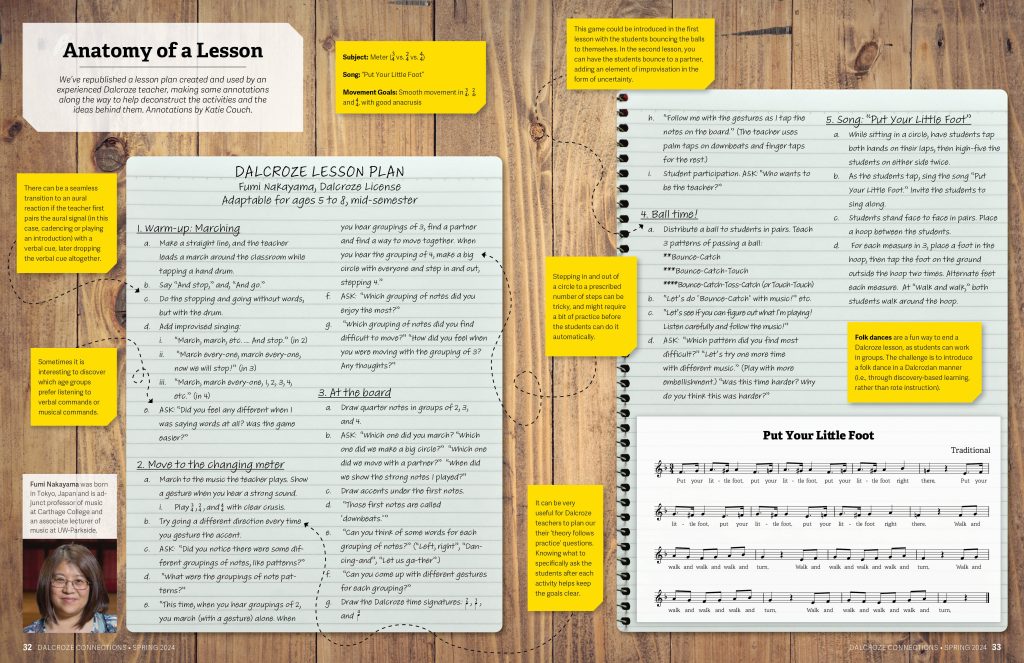
Lesson Plan
- Warm-up: Marching
- Make a straight line, and the teacher leads a march around the classroom while tapping a hand drum.
- Say “And stop,” and, “And go.”
- Do the stopping and going without words, but with the drum.1
- Add improvised singing:
- “March, march, etc. …. And stop.” (in 2)
- “March every-one, march every-one, now we will stop!” (in 3)
- “March, march every-one, 1, 2, 3, 4, etc.” (in 4)
- ASK: “Did you feel any different when I was saying words at all? Was the game easier?”2
- Move to the changing meter
- March to the music the teacher plays. Show a gesture when you hear a strong sound.
- Play {3/4}, {2/4}, and {4/4} with clear crusis.
- Try going a different direction every time you gesture the accent.3
- ASK: “Did you notice there were some different groupings of notes, like patterns?”
- “What were the groupings of note patterns?”
- “This time, when you hear groupings of 2, you march (with a gesture) alone. When you hear groupings of 3, find a partner and find a way to move together. When you hear the grouping of 4, make a big circle with everyone and step in and out, stepping 4.”4
- ASK: “Which grouping of notes did you enjoy the most?”
- “Which grouping of notes did you find difficult to move?” “How did you feel when you were moving with the grouping of 3? Any thoughts?”
- March to the music the teacher plays. Show a gesture when you hear a strong sound.
- At the board
- Draw quarter notes in groups of 2, 3, and 4.
- ASK: “Which one did you march? “Which one did we make a big circle?” “Which one did we move with a partner?” “When did we show the strong notes I played?”
- Draw accents under the first notes.
- “Those first notes are called ‘downbeats.’”
- “Can you think of some words for each grouping of notes?” (“Left, right”, “Dan-cing-and”, “Let us ga-ther”.)
- “Can you come up with different gestures for each grouping?”
- Draw the Dalcroze time signatures: {2/q}, {3/q}, and {4/q}
- “Follow me with the gestures as I tap the notes on the board.” (The teacher uses palm taps on downbeats and finger taps for the rest.)
- Student participation. ASK: “Who wants to be the teacher?”
- Ball time!5
- Distribute a ball to students in pairs. Teach 3 patterns of passing a ball:
**Bounce-Catch
***Bounce-Catch-Touch
****Bounce-Catch-Toss-Catch (or Touch-Touch) - “Let’s do ‘Bounce-Catch’ with music!” etc.
- “Let’s see if you can figure out what I’m playing! Listen carefully and follow the music!”
- ASK: “Which pattern did you find most difficult?” “Let’s try one more time with different music.” (Play with more embellishment.) “Was this time harder? Why do you think this was harder?”
- Distribute a ball to students in pairs. Teach 3 patterns of passing a ball:
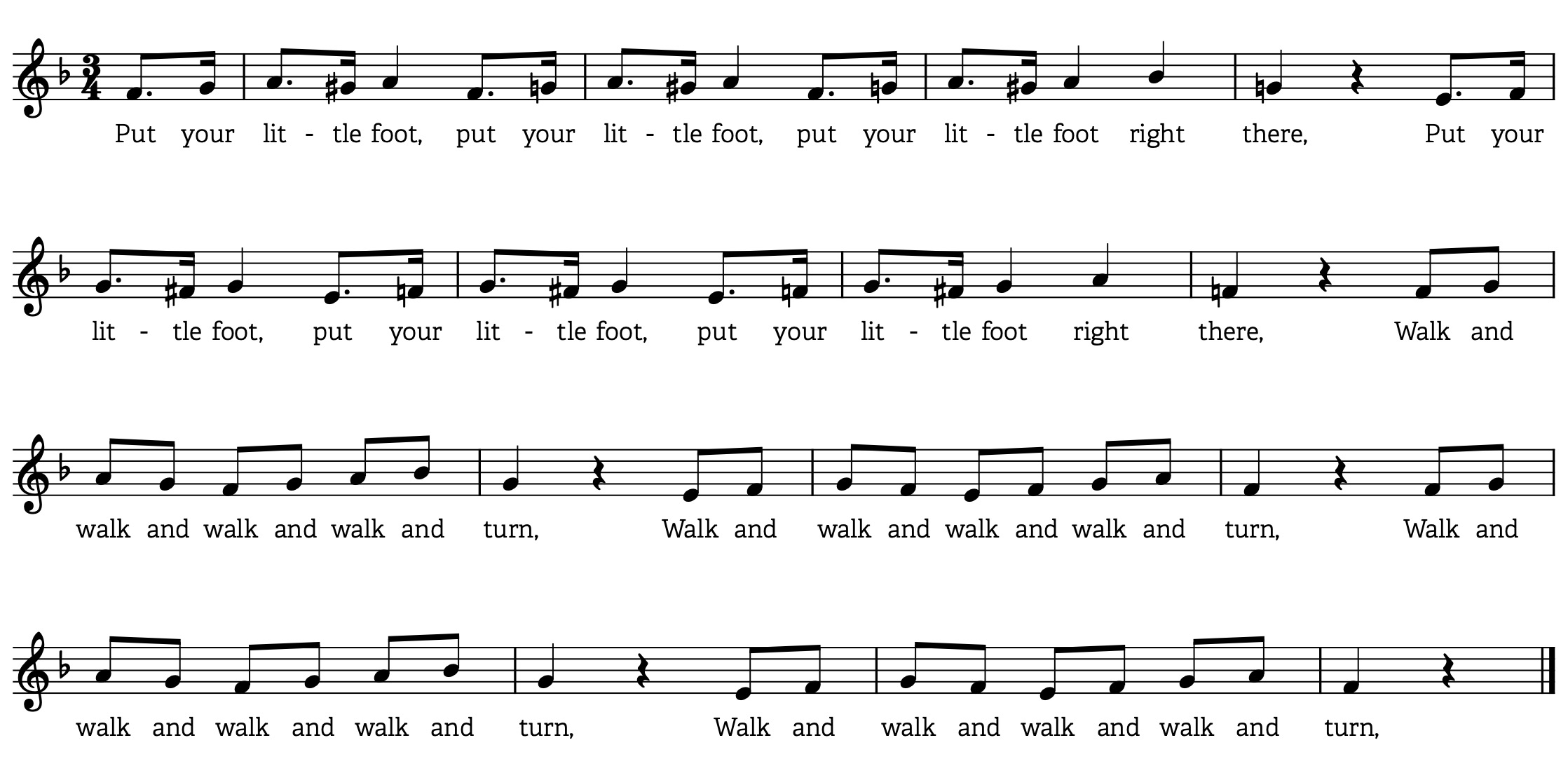
- Song: “Put Your Little Foot”6
- While sitting in a circle, have students tap both hands on their laps, then high-five the students on either side twice.
- As the students tap, sing the song “Put Your Little Foot.” Invite the students to sing along.
- Students stand face to face in pairs. Place a hoop between the students.
- For each measure in 3, place a foot in the hoop, then tap the foot on the ground outside the hoop two times. Alternate feet each measure. At “Walk and walk,” both students walk around the hoop.
Commentary
- There can be a seamless transition to an aural reaction if the teacher first pairs the aural signal (in this case, cadencing or playing an introduction) with a verbal cue, later dropping the verbal cue altogether. ↩︎
- Sometimes it is interesting to discover which age groups prefer listening to verbal commands or musical commands. ↩︎
- It can be very useful for Dalcroze teachers to plan our their ‘theory follows practice’ questions. Knowing what to specifically ask the students after each activity helps keep the goals clear. ↩︎
- Stepping in and out of a circle to a prescribed number of steps can be tricky, and might require a bit of practice before the students can do it automatically. ↩︎
- This game could be introduced in the first lesson with the students bouncing the balls to themselves. In the second lesson, you can have the students bounce to a partner, adding an element of improvisation in the form of uncertainty. ↩︎
- Folk dances are a fun way to end a Dalcroze lesson, as students can work in groups. The challenge is to introduce a folk dance in a Dalcrozian manner (i.e., through discovery-based learning, rather than rote instruction). ↩︎
Submit Feedback on This Resource

Fumi Nakayama
Fumi Nishikiori-Nakayama earned her Bachelor of Music in Piano and Harpsichord degree from the Chicago Musical College of Roosevelt University, and Master of Music in Piano and Early Music/Harpsichord from Indiana University, where she was the recipient of numerous awards including the prestigious Rudolph Ganz Memorial Award, and Willi Apel Scholarship. She has studied piano with Ludmila Lazar, Shigeo Neriki, harpsichord with David Schrader, Elisabeth Wright, fortepiano with Elizabeth Wright and Kenneth Drake, chamber music with Rostislav Dubinsky, early chamber music with Stanley Ritchie, and conducting with Thomas Baldner and Imre Pallo.
As a conductor, she has conducted Indiana University Symphony Orchestra, IU Ad-hoc Orchestra, IU Opera Workshops. Her love for vocal music and theater lead her to remain as one of the opera coaches for Indiana University Opera Theater for 6 years.
Currently Ms. Nishikiori is an adjunct faculty member of the Carthage Music Department and teaches for the Carthage Arts Academy. She has received the Dalcroze Certificate from Dr. Robert Abramson at Juilliard School Dalcroze Institute and received the Dalcroze License from Dr. Jeremy Dittus of the Dalcroze School of Music and Movement. She often gives demonstrations and lectures to music teachers and students in the Midwest. She frequently performs as a member of Trio Celeste, and also collaborates with greater Milwaukee and Chicago area artists.
Katie Couch
Katie Couch holds degrees in music performance and education from the University of Colorado Boulder. She earned the Dalcroze Professional Certificate and License from the Dalcroze School of the Rockies (now the Dalcroze School of Music and Movement). Katie is on the faculty of the Dalcroze School of Music and Movement, where she trains future Dalcroze teachers in eurhythmics, improvisation, solfège, and pedagogy. Katie also volunteers for several committees of the Dalcroze Society of America, most notably serving as treasurer, chair of the publications committee, and managing editor of Dalcroze Connections.
Anatomy of a Lesson #4
Changing Meters of 2, 3, and 4
Fumi Nakayama, Author
Katie Couch, Editor


About the Author(s)
Fumi Nakayama
Fumi Nishikiori-Nakayama earned her Bachelor of Music in Piano and Harpsichord degree from the Chicago Musical College of Roosevelt University, and Master of Music in Piano and Early Music/Harpsichord from Indiana University, where she was the recipient of numerous awards including the prestigious Rudolph Ganz Memorial Awar…
Katie Couch
Katie Couch holds degrees in music performance and education from the University of Colorado Boulder. She earned the Dalcroze Professional Certificate and License from the Dalcroze School of the Rockies (now the Dalcroze School of Music and Movement). Katie is on the faculty of the Dalcroze School of Music and Movement, whe…


Leave a Reply
You must be logged in to post a comment.