
Interview
Adaptation
A Conversation on the Dalcroze Principle


Published Fall 2026 | Added November 10, 2026
How can teachers balance lesson plans with responsiveness to students? This interview explores adaptation through improvisation, creative exploration, and practical strategies for the classroom.
This transcript has been edited for length and clarity.
Understanding Adaptation as a Dalcroze Principle
INTERVIEWER: Thank you for participating in this interview on the new Dalcroze principle of adaptation. So, Jeremy, could you start us off by explaining this principle and why it came to be?
JEREMY: Adaptation is something that has been around for a long time as an idea. I think that, first and foremost, we see adaptation in so many facets as musicians. We are constantly asked to adapt to the score, to other players, to a conductor, to new instruments (if you’re a pianist). I think that it’s really in our bones just as musicians.
In terms of Dalcroze, it’s a little bit more complicated than that. Jaques-Dalcroze actually refers to adaptation or the idea of adapting, or the word “adapt,” almost sixty times in his books Eurhythmics Art and Education and Rhythm, Music, and Education. I think he was keenly aware that [adaptation] was something that was supposed to happen. For others who are involved in this work, for example, the Collège, they’ve produced a document called “The Dalcroze Identity,” and in that document, adaptation occurs—or some derivative of it—over thirty times. So, I think people have always been talking about this.
When we came up with the initial version of the Teacher Training Manual for Certification and Licensure document a long time ago, we basically couched adaptation under the idea of improvisation, and sometimes people would refer to it as a means or as a technique, that kind of thing, but not necessarily as a principle. And indeed, Madeleine Duret has a document where she talks about adaptation, and she couches it there under faculties and aptitudes that are developed in the method.
So, anyway, I’m just trying to set up that adaptation has been mentioned in all sorts of documents for a long time. And in ours we decided not to list it as a principle at the beginning; we kind of couched it more as a technique. But, when COVID came around and we were not able to interact in the same ways because we were working online with Zoom, Skype, etc. for our classes, it became very clear that adaptation was really important.
When we took that element out of a Dalcroze environment where students could not adapt to one another, and teachers could not adapt to students as readily because there was a delay, and everyone was adapting to different types of space, it made it very difficult for the teacher to begin to address that. It became important to us or clear to us that this was something that we needed to address.
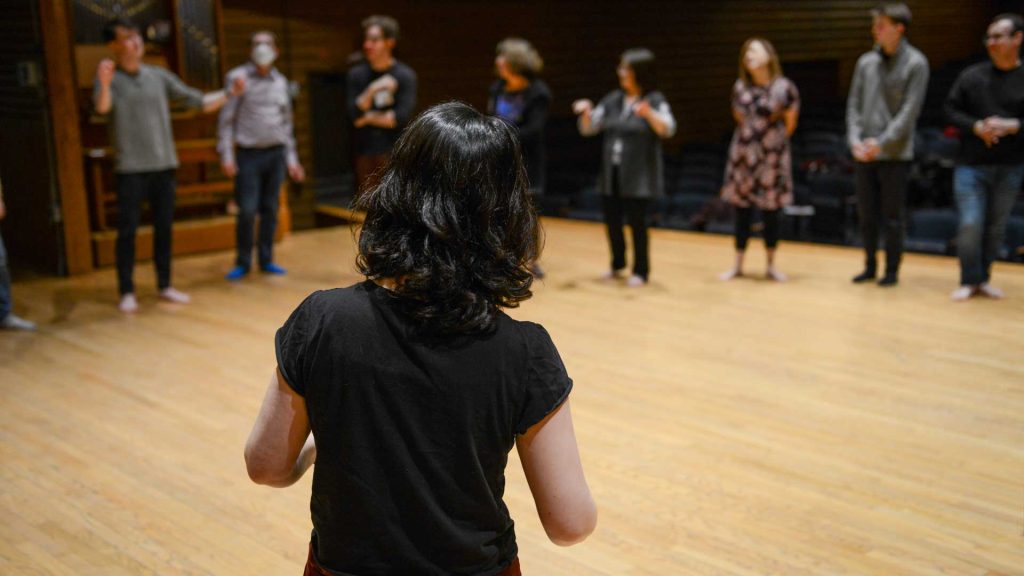
BILL: In my own training, the word itself, “adaptation”—I don’t recall it occurring as such. My training was initially with Bob Abramson and Ruth Alperson. And yet, training itself was infused with the importance of responding to the students, responding to the emerging situation that was the class itself, [responding to] emerging elements that are coming up musically or pedagogically, or even emotionally, socially. Without knowing that we were using the word “adaptation,” we were applying this technique or skill or principle, whatever you want to call it.
My teaching is constantly involved in observing the students and responding to them, responding to what they’re doing, sometimes by changing the lesson, sometimes by amplifying certain elements that I’m bringing out in the lesson, but sometimes by even switching gears altogether and doing a completely different activity. It all depends on what’s called upon.
Without knowing that we were using the word “adaptation,” we were applying this technique or skill or principle, whatever you want to call it.
Bill Bauer
There seems to be a balancing in the practice in general—what I’ve noticed in my teaching especially, but in others that I’ve observed—between responding and sticking to one’s plan. In other words, you have a goal, you have an idea of what you want to do in the lesson, maybe you have a piece of music that you want to get to, and if you’re constantly adapting, it’s possible that you won’t ever get to that piece at the end of the lesson, or you won’t achieve the goals that you had set in your lesson plan. And so, rather than see it as this sort of absolute principle, I tend to see it as something that’s on a spectrum between integrity to the lesson and responsiveness to the students and the situation.
Balancing Responsiveness and Intention
INTERVIEWER: How do you teach people who are aspiring Dalcroze teachers to achieve that sort of balance in their lessons?
JEREMY: I think it all depends on what your goals are in the moment. I think it’s really—it’s a dynamic process to adapt. It’s not “And now here’s my little moment of adaptation.” I don’t think that’s how it works, and I think it’s one of the reasons why it can be difficult to teach. But I think it really matters what your goals are in the moment.
What Bill was talking about, for example, has to do with the teacher and making adaptations to the students. Sometimes we need the students to make adaptations to each other. We might have a situation where, let’s say, you have a student who’s struggling to stay in time with the beat or with matching a rhythmic pattern. One of the ways that we can use adaptation as a principle in this context is to change the way we play. So, we change our music and then we ask them to adapt to that music. Maybe we change the tempo, maybe we change the style, maybe we change the character. Those are all things that we can do, and that’s kind of like within our capacity at the piano.
But then sometimes, a way that we can do this is to get them to work with a partner. And as soon as you introduce partner activities, that requires a fairly high degree of sophistication when it comes to adaptations. People have to adjust what they’re doing; they have to sense or communicate with their partners, oftentimes nonverbally, to make that adaptation happen.
Then, of course, there’s the idea of students making adaptations to their own space, or even the teacher adapting to the students. Instead of the students adapting to the teacher’s playing, the teacher may adapt to the students. For example, I might say, “Katie, go for a walk, and you decide the tempo, you decide what’s going to come out of the music in your inner ear,” and then I adapt to that. I will change what I’m doing to support you.
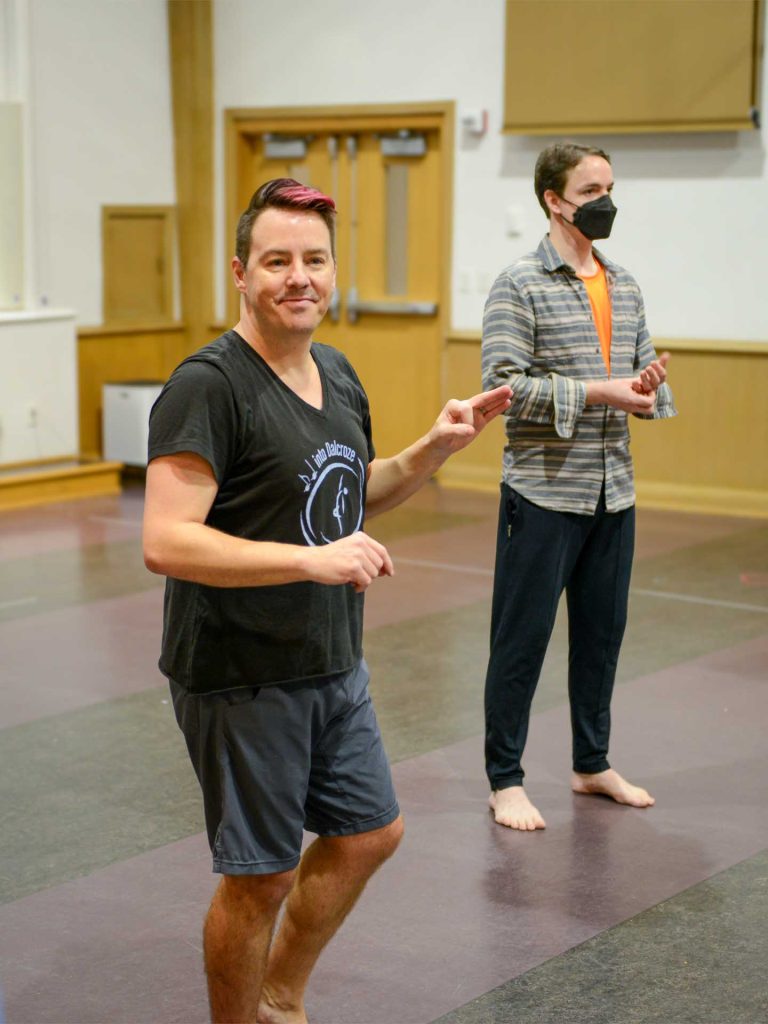
I think, too, when we talk about student-to-student adaptations, I think that’s also really important. For example, you might have students tapping a pattern together, and maybe they’re just tapping it like so, touching palms. And then you might say, “Find another way.” And as soon as that change is introduced, then they have to figure out something different to do. That’s again an example of adaptation in that moment. They still need to show the pattern, but they have to find a different way of doing it.
All of that kind of adaptation is a part of what we do in the class. So, all of that’s to say, if I’m teaching this, if I’m teaching this to someone who’s new to the method, the first point is: What is your goal? What do you want to have happen? It may be that adaptation is a really appropriate event to impart at that moment. So, I think that it’s really a case-by-case basis, if that makes sense.
BILL: Bob Abramson constantly would have us try another way. That was one of his expressions. We used to joke about it, actually. We’d be sitting having coffee and somebody would say, “Will you pass the sugar?” and somebody’d say, “Try another way,” or, you know, it’s just stupid things, but the point was that he was constantly teaching creativity. And I think the reason that we didn’t use the word “adaptation” per se is because Bob felt that he was teaching us creativity, and he emphasized that a lot in the teaching.
In my teaching with college students, I certainly emphasize creativity. I think as Dalcroze teachers, we model responsiveness, adaptation, creativity—whatever you want to call it—in the ways that we interact with the students, with the materials of the lesson, and with the music itself.
I also think that allowing the students the process of exploration, really letting them make discoveries rather than end-goaling, so to speak, telling or signaling to them, “This is where we’re headed. This is what we’re trying to get to,” but letting them find their way, is in effect teaching them the essence of responsiveness or adaptation.
Adaptation, Improvisation, and Creativity
INTERVIEWER: Would you agree that using a combination of Dalcroze teaching techniques or strategies, such as quick reactions or group activities or improvisation, helps us achieve this principle of adaptation?
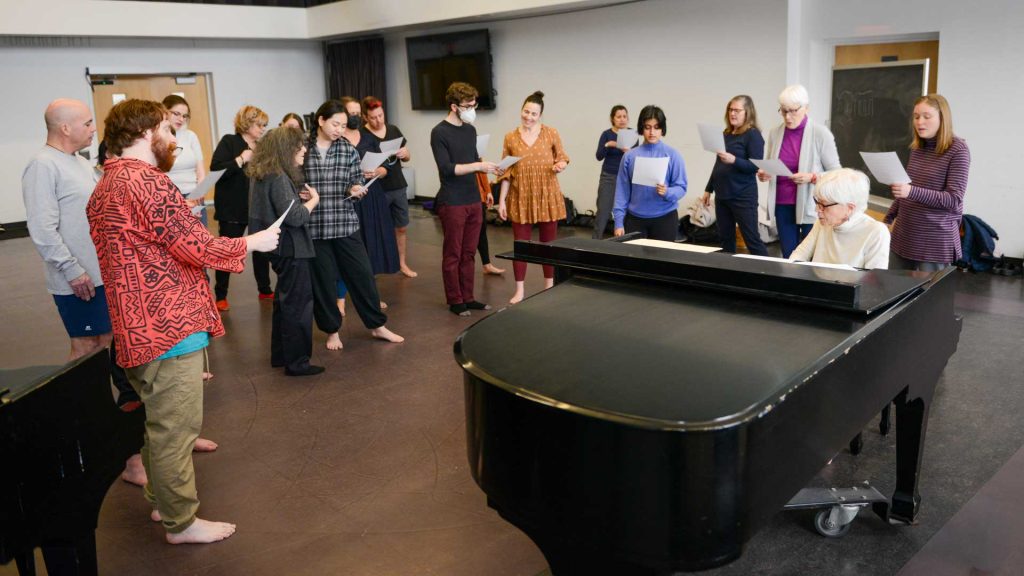
BILL: If the teacher emphasizes creativity and is open to and encourages us to respond creatively, then I think those are pathways to adaptation. What I would say is the genius in the method is emphasizing improvisation in the actual substance of what we teach. In the actual skill sets that we require the students to develop, we are giving them the tools to be responsive to their environment, in and outside of the classroom. It becomes almost a matter of expanding your personal character so that you can be responsive in a conversation with someone or to an emergency that’s arising. How do you express who you are in a given situation in response to that? Quick reactions and all the other Dalcroze teaching techniques are ways of breaking down the elements of spontaneity so that your mind has the flexibility of response to change at the drop of a hat or sur le vif, as they say.
JEREMY: If you go back and look at Jaques-Dalcroze’s texts, he has many ways that he discusses adaptation, and I want to share with you one of them that I thought was very interesting. This is from Eurhythmics Art and Education on page 106:
Before adapting his nature to the movement and sound of an instrument, the pupil should be capable of experiencing in his own body and then of analyzing both motor and aural sensations. Special exercises will first develop his sense of muscular rhythm and his nervous sensibility, and then they will render his ear attentive to all gradations of intensity, duration, and time, phrasing and shading, so that his limbs may faithfully reproduce the rhythms perceived by the ear. Hence, the student will find himself in a better condition for motor receptivity as well as better prepared to take up studies that aim at converting impression into expression. The teacher will then seek to diminish the time lost between impression and the faint desire for expression by means of exercises whose object is to develop greater spontaneity both in the motor centers and in the imagination. When all of his movements have become rhythmical, a child learns to think and express himself rhythmically.
I think that’s interesting because it is talking a little bit about what Bill was saying about this idea of creativity and expression. All of us have these in different capacities, but it kind of comes back to what are our techniques, what are our strategies that we use, and how does this demonstrate our principles of the method?
So, for me, virtually any of the strategies and techniques are going to require, to some degree, flexibility, suppleness, and adaptation. And the way that Jaques-Dalcroze just described it, in my reading, is the goal is to get that whittled down—the amount of time between the signal that the student hears or sees or feels to be as short as possible, so that way they can represent and embody the music more easily, more convincingly. When that happens, then there’s this idea that, “Oh, now they have freedom to think about other things, things like expression.” That helps, in my opinion, to stimulate creativity. So, all these strategies and techniques point to that principle of adaptation. And I think it’s one of the reasons why it’s made the top ten, so to speak.
BILL: That time span between impression and response to what we’re hearing and then reproducing was described to me as temps perdu, the amount of time that’s lost from going from hearing and or taking in the information, and the action that results. The afferents and then the efferents, basically, the intaking of impressions and then the release in whatever response or reaction we have.
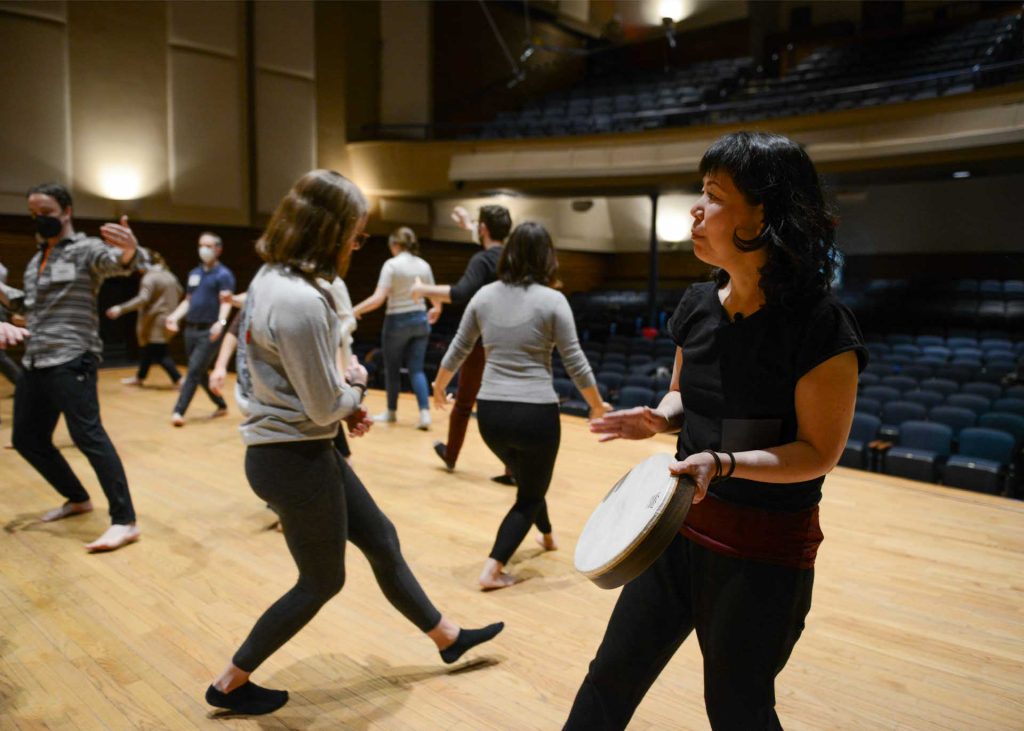
JEREMY: Right, and I think that with this method, the reason why adaptation to me is just so imperative is because it has so many ramifications for us. When we are in a classroom environment and you’ve got, let’s say, thirty people moving in the space—and they may not even be people that you know—we are constantly adjusting and making these adaptations. We are adapting as teachers in so many ways, and I think that the students are also adapting in so many ways to the space and to one another. And by doing these types of reactions and bringing down the temps perdu, whittling it down so that way it’s almost immediate, I think it has a huge impact on our ability to perform because there are times—I think we’ve all been there where we are playing and we might not even realize all of the things that we are doing in the moment and things that have to just be automatic.
And in the moment that we are doing all of this at the piano, let’s say we’re playing with a singer and the singer decides to take time—we have to be able to adjust immediately to that. The temps perdu has to be so little, so narrow, that we can stay with them. I can say that from my personal experience, that was always very challenging for me to be able to do that in accompanying, and it’s one of the things that I think I love about this work because it has given me real tools to improve that skill.
Planning for Adaptation in the Classroom
INTERVIEWER: What I’m hearing is that adaptation has been a part of this work since its inception and it appears in many different forms under different guises, but it’s a core feature of this practice. I wonder if you could speak a moment to those people who are striving to become better at this practice of leading a Dalcroze session, of some concrete ways they can include adaptation, whether it’s in their lesson-planning process or the teaching process. Do you have ideas about how to better achieve that?
BILL: I would say that one of the real challenges to planning a Dalcroze lesson, if you’re really given over to this idea of being responsive to the human beings that you have in front of you at that moment when you’re teaching, is designing a lesson where you’re going to create these activities, but to also leave space in the lesson that allows for responsiveness; flexibility; creativity, openness to what the students are actually doing in front of you. You might design a wonderful activity, and then it turns out that two or three of the students just simply can’t do it; you didn’t know that before you started it.
So I think always when I sit down to plan a lesson, I have this moment of panic because I’m supposed to design this structure, but I also need to remind myself that these are breathing human beings that are going to, as Jeremy says, adapt to the structure of the lesson in whatever ways are personal to them or human for them. And that can be in a whole range of possibilities.
JEREMY: I agree with everything that Bill just said: There is oftentimes a moment of panic when you’re starting to develop a lesson plan. Because you don’t know how it’s going to go, you don’t know exactly what’s going to happen. That’s part of the thrill of the work at some level, and it’s part of what makes it so exciting: It’s never finished.
For me, I try to be really specific in my lesson planning; if I want to make sure that I’m demonstrating adaptation as a principle, I have clear moments where that’s going to be the case. Any time you are in a Dalcroze environment and you say to the students, “Invent a way of moving that I’ve never seen before,” and then you go to the piano when you play for it, is a situation where the teacher is adapting to the students. Sometimes we do this in an improvisation class.
That’s part of the thrill of the work at some level, and it’s part of what makes it so exciting: It’s never finished.
Jeremy Dittus
Another example is when, let’s say, “I’m going to step a pattern, and when I change to diminution of this pattern, then you follow me. And if I change to augmentation, you follow me. You adapt to me.” Any time that happens, it’s a way of making that kind of interaction take place.
There can also be adaptations between students as well; you can set up activities, for example, with mirroring. You have two students facing one another: person A is the leader, and person B is the follower. Let’s say person A raises their left hand and then person B mirrors them, for example, and they would be raising their right hand. You can say change, and then person B has to be the leader.
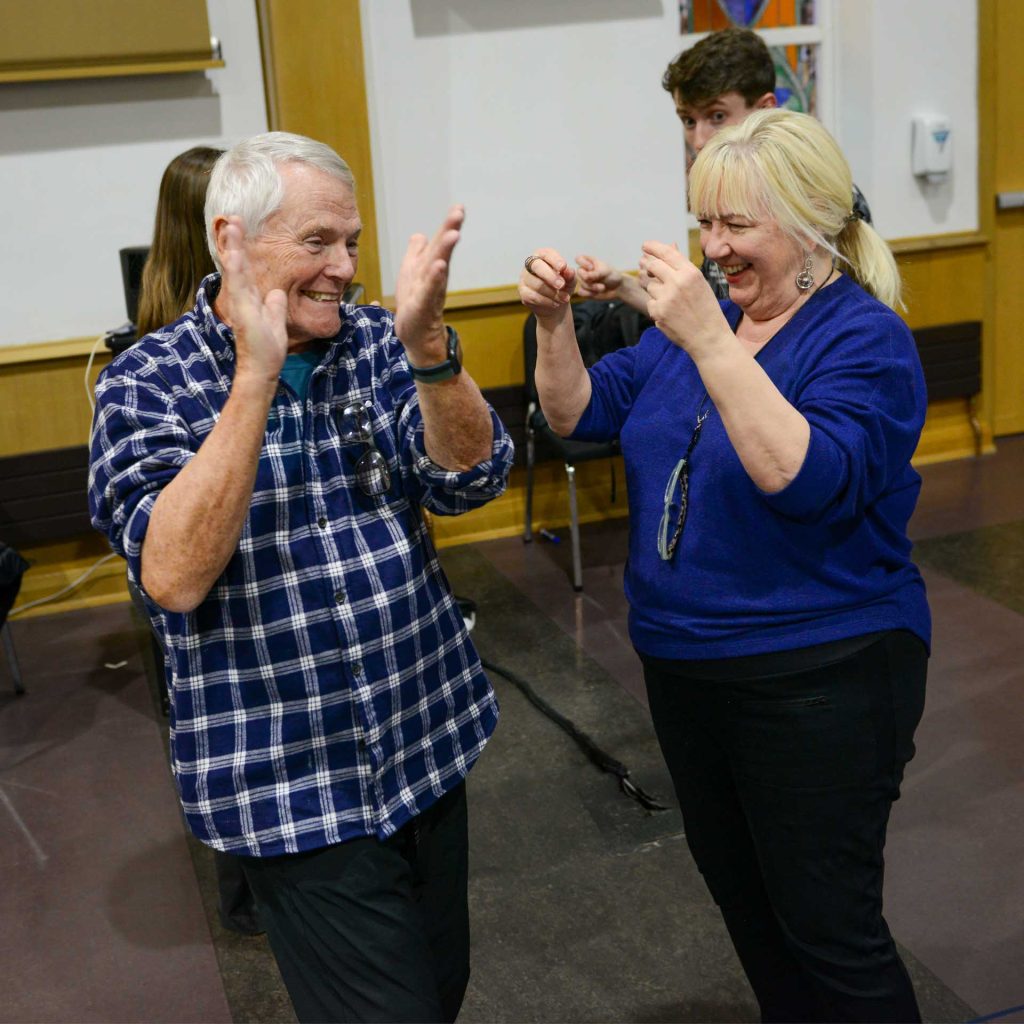
Any time there’s an activity like that, where students have to adapt to one another, can absolutely be planned into your lessons. So in many Dalcroze activities, you can see adaptation unfold, which I think helps clarify part of this big mystery about imparting information in a discovery-based way.
In Dalcroze education, the imparting of information is different because it’s a real unfolding. You as the new teacher trying these ideas out, you need to be in a position where you can try very specifically.
Another way that you can do this, which was one way that Lisa Parker did with us (I’ll never forget this lesson)—we ended up moving into a different building once, and it was very unsettling. Nobody knew where to go and people were rushing and they were exhausted. We were moved into this room that was oblong; it had two stories, all of this beautiful carved woodwork, and also a whole bunch of furniture that probably shouldn’t have been in there for a Dalcroze class.
Lisa used the environment as a way to center us. She said, “I’m going to play music for you to move to. When the music stops, I want you to freeze and turn yourself into a sculpture of something in the space.” There were these Corinthian columns, and someone made themselves into a little sculpture and they made their hands be the Corinthian petals that were coming out of the column. Somebody else turned themselves into an armchair, which was again just very cool and interesting. That’s a way that students then are adapting to the space around them.

Cultivating Responsiveness Through Discovery
INTERVIEWER: When you could plan for activities where the elements of time, space, or energy change, then you are incorporating adaptation in some way.
BILL: Because we had such a positive experience in our Dalcroze classes, and we delighted in the creativity that was both demonstrated by our teachers and summoned forth from within us, it made it easy for us to teach that way ourselves.
Many of the students who come into my class don’t expect it to be Dalcroze per se, (it’s called Musicianship). There’s something a bit terrifying about a Dalcroze class, and it’s because my students are accustomed to the learning process being something much more concrete in the sense that they are told what they are expected to do; they are supposed to learn how to do it; and then they either perform it well or not. In a very particular way, in their minds, they know exactly what the goal is.
When we ask the students to discover the answer to a particular situation, we are really asking them to explore in a way that they have not been called upon to do, in a way that’s expressive; in a way that asks them to show the results of their exploration in real time. This makes it challenging to teach Dalcroze, because the students are called upon to be responsive.
The exercises that Jeremy was describing are great training wheels, so to speak, for that kind of responsiveness training.
INTERVIEWER: Thank you so much for your time in discussing adaptation with me today!
Submit Feedback on This Resource

William R. Bauer
William R. Bauer teaches at the College of Staten Island/CUNY, where he has served on the full-time music faculty since 2002.
Dalcroze credentials: diplôme supérieur, 2023 (Institut Jaques-Dalcroze, Geneva); Dalcroze License, 1990 (Manhattan Dalcroze Institute, New York); Dalcroze Certificate, 1983 (Manhattan Dalcroze Institute). Academic credentials: PhD in Composition, 1996 (CUNY Graduate Center, New York); MA in Composition, 1987 (Columbia University); BS in Music, 1981 (Empire State College, SUNY).
Employment: full-time faculty, College of Staten Island, CUNY, 2002–present (Music Program and Music Events Coordinator since 2024; American Studies Director, 2017–2024); full-time faculty, Rutgers University–Newark, 1994–2002.
Community service: president, Dalcroze Society of America, 2012–18; DSA executive director, 2018–19; Professional Development Committee, 2023–present; Council of Diplômés, 2023–present; other committees intermittently since 2019.
Numerous publications on Dalcroze Eurhythmics, most recently “Dalcroze Education in the United States: Building a Community of Practice,” in *Navigating Landscapes of Dalcroze Practice* (Boydell Press, 2025), pp. 129–43; and on jazz vocal performance practice, including the critically acclaimed book *Open the Door: The Life and Music of Betty Carter* (University of Michigan Press, 2002), as well as peer-reviewed book chapters and articles in scholarly journals.
Actively leads Dalcroze workshops for participants of all ages in a variety of contexts. Director of Windrows Warblers, a chorus of high-functioning seniors who perform concert versions of Broadway shows and other vocal literature. Currently offering “Speaking in Tones,” readings of international poetry in English translation enriched by responsive musical landscapes improvised at the keyboard. Recent programs have featured the work of Palestinian poets.

Jeremy Dittus
Dr. Jeremy Dittus, Diplôme Supérieur, enjoys a career as a pianist, theorist, and Dalcrozian. He has performed and/or presented Dalcroze master classes throughout the United States, Europe, and Southeast Asia. He directs the Dalcroze School of Music & Movement (Dallas, Texas), teaches on the faculty at Hope College in Holland, Michigan, and serves on le Collège de l’Institut Jaques-Dalcroze. The Dalcroze School of Music & Movement (founded in 2010) offers courses for youth ages 4–18, adult enrichment, full-time study toward the Dalcroze Professional Certificate, Dalcroze License, and post-License study. Publications include several journal and book articles, seven volumes of teacher-training textbooks, Embodying Music Vol. I–IV and Moving Sound Vol. I–III, along with ten volumes of DSM youth curriculum: Eurhythmics I and II, Rhythmic-Solfège I–V, and Advanced Dalcroze I–III.
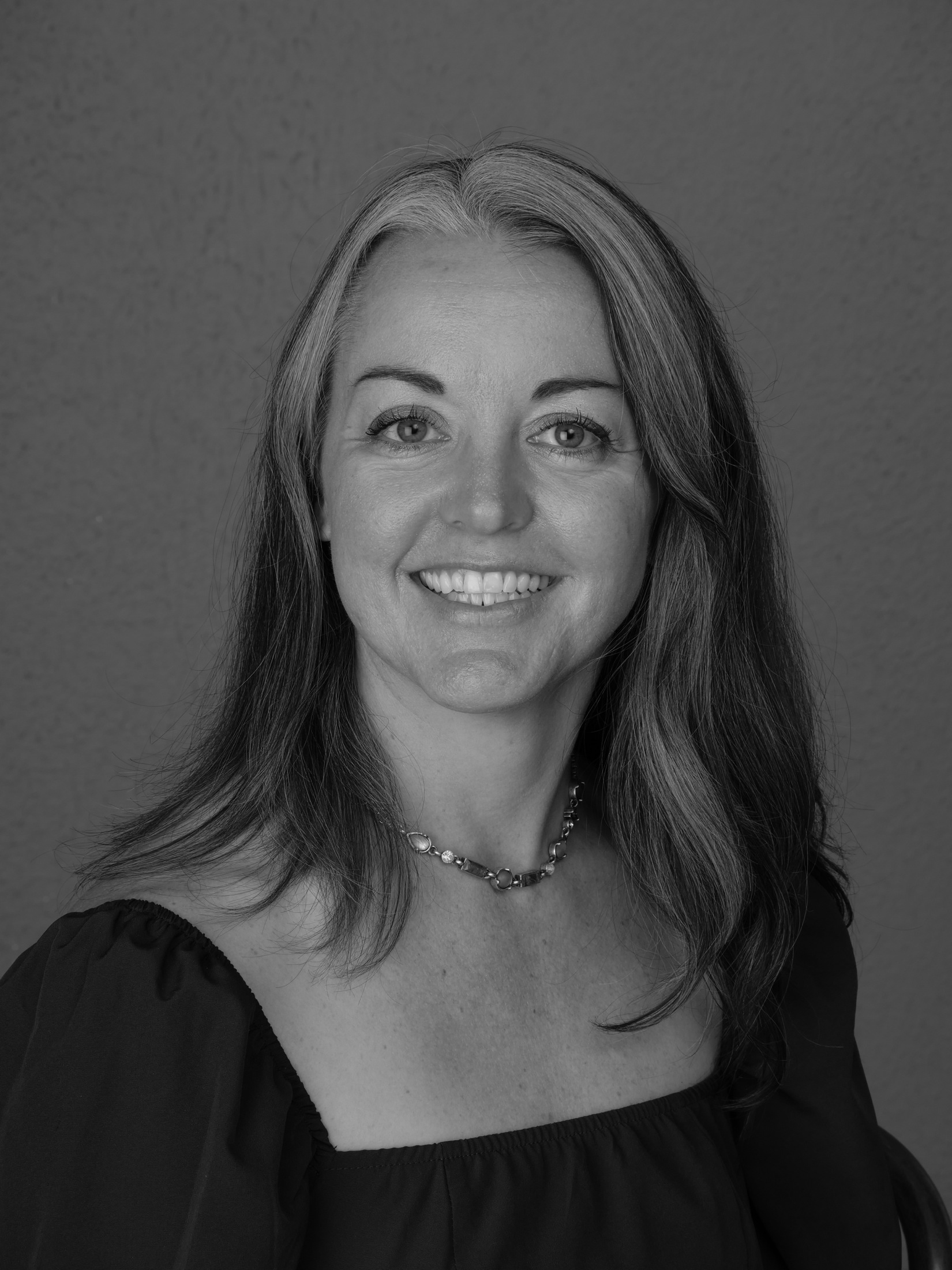
Katie Couch
Katie Couch holds degrees in music performance and education from the University of Colorado Boulder. She earned the Dalcroze Professional Certificate and License from the Dalcroze School of the Rockies (now the Dalcroze School of Music and Movement). Katie is on the faculty of the Dalcroze School of Music and Movement, where she trains future Dalcroze teachers in eurhythmics, improvisation, solfège, and pedagogy. Katie also volunteers for several committees of the Dalcroze Society of America, most notably serving as treasurer, chair of the publications committee, and managing editor of Dalcroze Connections.
About the Author(s)
William R. Bauer
William R. Bauer teaches at the College of Staten Island/CUNY, where he has served on the full-time music faculty since 2002.
Dalcroze credentials: diplôme supérieur, 2023 (Institut Jaques-Dalcroze, Geneva); Dalcroze License, 1990 (Manhattan Dalcroze Institute, New York); Dalcroze Certificate, 1983 (Manhattan Dalcroze In…
Jeremy Dittus
Dr. Jeremy Dittus, Diplôme Supérieur, enjoys a career as a pianist, theorist, and Dalcrozian. He has performed and/or presented Dalcroze master classes throughout the United States, Europe, and Southeast Asia. He directs the Dalcroze School of Music & Movement (Dallas, Texas), teaches on the faculty at Hope College in H…
Katie Couch
Katie Couch holds degrees in music performance and education from the University of Colorado Boulder. She earned the Dalcroze Professional Certificate and License from the Dalcroze School of the Rockies (now the Dalcroze School of Music and Movement). Katie is on the faculty of the Dalcroze School of Music and Movement, whe…


Leave a Reply
You must be logged in to post a comment.